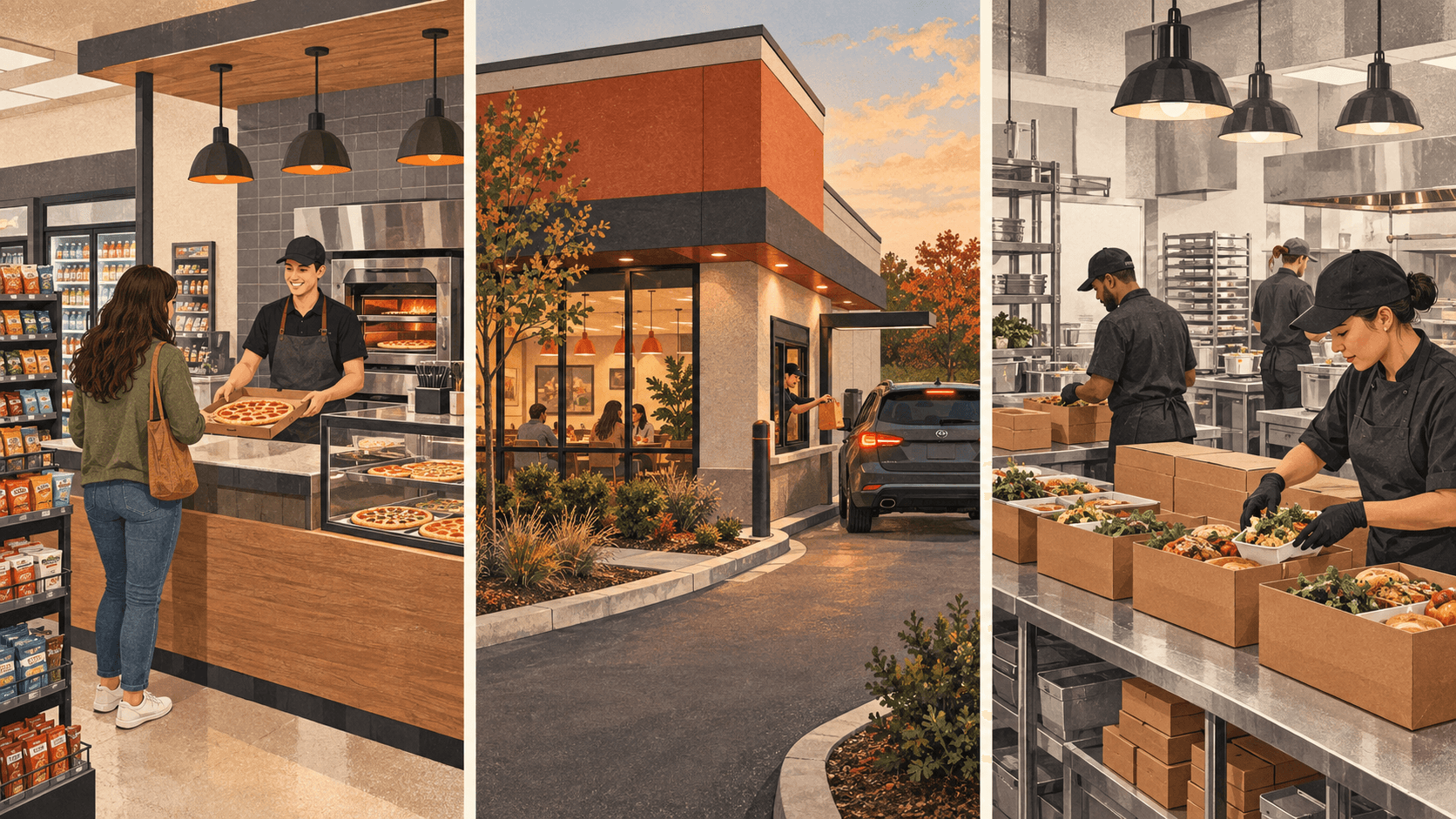
The dining room is becoming a back-of-house function.
That is the operational reality emerging from the industry's own data. According to a 2026 Mordor Intelligence analysis of the off-premise food service sector, drive-thru, delivery, and takeaway formats now account for more than 70% of revenue at leading QSR brands. Pre-pandemic, that figure sat around 60% for the top chains. The pandemic accelerated the shift by several years, consumer behavior calcified around it, and operators are now building permanent infrastructure around a customer who never comes inside.
The numbers are not a blip. They are a mandate.
The Drive-Thru Still Dominates, But It Is Being Rebuilt#
For all the attention on delivery apps and mobile ordering, the drive-thru remains the load-bearing pillar of QSR off-premise revenue. At McDonald's, approximately 70% of U.S. systemwide revenue flows through drive-thru windows. That single data point explains why the chain is overhauling more than 27,000 drive-thru locations globally, adding multi-lane configurations and AI-assisted ordering to shorten service times and capture more throughput per location.
McDonald's investment in drive-thru infrastructure is not cosmetic. It represents a strategic bet that speed of service translates directly into revenue. Each additional car served per hour during peak periods adds meaningful sales across a system generating tens of billions annually. The chain's new formats include parallel lanes, dedicated mobile order lanes, and AI voice ordering systems designed to reduce human error and handle menu complexity at scale. The AI ordering pilots showed enough accuracy improvement that McDonald's has been expanding them system-wide, with voice recognition that handles upsells and promotional items without cashier involvement.
The competitive pressure is cascading down the industry. Chains that cannot match the throughput of a redesigned McDonald's drive-thru risk losing transactions at the margin, exactly where the fast food model lives.
Delivery Economics: The Commission Problem That Won't Disappear#
Third-party delivery grew the off-premise pie, and then proceeded to eat a significant portion of the margins that came with it. Commission rates from DoorDash and Uber Eats typically run between 15% and 30% per order depending on contract terms, platform tier, and whether the operator is purchasing marketing placement on top of the base rate. For a chain with food cost running 28-32% and labor cost running 25-30%, surrendering another 25 cents on every delivery dollar is not a manageable long-term position.
Operators have responded by building out first-party ordering channels, but first-party digital ordering requires its own investment: app development, loyalty integration, push notification strategy, and customer acquisition. The economics only work at scale, which creates an advantage for large chains while squeezing regional and smaller operators who lack the marketing budget to pull customers off the third-party platforms.
Olo took direct aim at this dynamic in 2026 with the launch of a zero-commission consumer ordering app designed to challenge the DoorDash and Uber Eats model. The Olo platform allows operators to capture direct ordering relationships without ceding margin to aggregators. Whether Olo can build sufficient consumer adoption to compete with the network effects that DoorDash and Uber Eats have accumulated over a decade is the real question, but the launch itself signals that the industry has reached a breaking point on commission economics. When a restaurant technology platform built its business on enabling delivery decides the commission structure is broken enough to build an alternative, operators should take notice.
Placer.ai data reinforces that delivery demand is structural, not cyclical. Dwell times at QSR locations have been decreasing steadily, reflecting customers who pick up their orders and leave immediately rather than eating on premises. The dining room experience is already priced out of the consumer's time budget. The restaurant's job is increasingly to produce the food, not provide the space.
Real Estate Is Being Rewritten Around Off-Premise Volume#
The implications for physical footprint are profound. Traditional QSR locations were designed around a balance of drive-thru lanes, counter service, and dining room capacity. That math is being torn up.
New builds are increasingly prioritizing kitchen production capacity, dedicated pickup shelving for third-party and first-party mobile orders, and expanded drive-thru lane configurations over dining room square footage. The dining room, where it exists at all, is being reduced to a utilitarian waiting area for order pickup rather than a place where customers linger.
Starbucks is executing one of the most visible examples of this redesign at scale. The chain announced plans to overhaul more than 1,000 locations with an emphasis on pickup efficiency and drive-thru capacity, deliberately scaling back the traditional cafe seating that defined its brand for decades. CEO Brian Niccol's "Back to Starbucks" strategy acknowledges that the third-place positioning the chain built its identity around has been functionally abandoned by its own customers, who use mobile order and drive-thru at rates that make the seating investment increasingly difficult to justify.
Shrinking dining rooms have direct cost implications. A smaller front-of-house means lower occupancy costs per revenue-generating square foot, reduced furniture and fixture capital expenditure, lower utility load, and fewer cleaning and maintenance requirements. The economics of a compact format can be substantially more attractive than the traditional footprint if off-premise volume holds.
Drive-thru-only formats are moving from pilot programs to standard development templates at several chains. These locations sacrifice walk-in traffic entirely to optimize lane throughput, kitchen flow, and order accuracy for a purely drive-thru customer. Real estate costs are lower because these sites require less square footage, can operate on parcels that would not support a full-format restaurant, and often eliminate the need for accessible parking beyond handicap requirements. The tradeoff is total dependence on drive-thru volume, with no fallback during equipment failures or weather events that slow lane movement.
Ghost kitchen hybrid models occupy a different niche. A traditional restaurant location operating a separate ghost kitchen menu for delivery-only orders can effectively run two revenue streams from one physical plant, one optimized for in-person and drive-thru transactions and one structured purely for third-party delivery. The overhead allocation math is complicated, but for operators in high-density urban markets where delivery demand is strong and real estate costs are punishing, the hybrid model can justify the operational complexity.
Labor Is Following the Revenue#
When 70% of revenue exits through drive-thru windows or delivery bags rather than dining room tables, staffing requirements change accordingly. The industry is in the middle of a structural reallocation of labor from front-of-house customer-facing roles toward kitchen production and order fulfillment positions.
The National Restaurant Association's 2026 State of the Industry report identifies off-premise growth as the top strategic priority among operators surveyed. Within that priority sits a labor challenge: kitchen throughput, not dining room service, is now the primary constraint on revenue during peak periods. That shifts where operators invest in training, where they concentrate their best-performing employees, and how they structure shift coverage.
Counter and cashier positions are being replaced by kiosks at an accelerating rate. The self-service kiosk adoption rate across QSR locations has passed 80% at brands that have deployed them, and the evidence on both labor savings and average check size has been positive enough that the industry is past the debate about whether to deploy kiosks and into the debate about how to configure them for optimal upsell performance. With front-of-house headcount declining, operator attention is turning to kitchen automation and expedite technology that can sustain throughput as order volumes rise.
Kitchen automation is advancing in parallel. Miso Robotics, after its acquisition by Zignyl in 2026, continues developing fry station automation that reduces the labor intensity of cooking. McDonald's is experimenting with humanoid robots at a Shanghai location in a Keenon partnership. These are early-stage tests, but they point toward a kitchen labor model where production tasks are increasingly machine-executed and human staff are concentrated on quality control, customization handling, and exception management.
Casual Dining Is Adapting, Not Immune#
The off-premise shift is not contained to QSR. The Applebee's and IHOP dual-brand concept, now operating at approximately 900 locations under Dine Brands, reflects a casual dining chain accepting the structural reality that foot traffic alone will not sustain unit-level economics. Dual-brand conversions reduce per-location real estate costs while keeping production capacity, and the delivery-optimized kitchen can serve both dining room orders and off-premise volume simultaneously.
The underlying dynamic is the same whether the check average is $8 or $22: customers have decided that convenience is worth paying for, and the physical restaurant is increasingly a production facility rather than an experience destination. For casual dining, which built its value proposition around the experience of eating out, this is a more existential challenge than it is for QSR, where the transactional relationship with customers was never primarily about ambiance.
The Unit Economics Are Being Restructured#
All of this adds up to a different picture of what a restaurant unit earns and costs than the model that prevailed before the off-premise inflection. The revenue side is larger at top-performing locations because drive-thru and delivery extend effective service capacity beyond what a dining room could handle. A location serving 300 covers in a dining room can potentially fulfill 600 or 800 orders per day when delivery and drive-thru are optimized.
The cost side is more complicated. Third-party commissions are a material headwind that did not exist in the pre-delivery era. Dedicated pickup infrastructure, double-sided packaging, and order accuracy technology are real capital expenditures. Kitchen equipment capable of sustaining higher throughput with consistent quality is not cheap.
Operators who have done the work to build owned digital channels, minimize third-party commission exposure, and invest in kitchen throughput capacity are generating unit economics that look meaningfully better than competitors still dependent on dining room occupancy and aggregator commissions. The gap between well-configured operators and the rest of the industry is widening.
The franchise community is watching this dynamic closely. Franchise disclosure documents for the major QSR brands now routinely include projections that assume significant off-premise revenue percentages. Franchisees evaluating new unit agreements need to understand the capital requirements for off-premise optimization, the realistic commission exposure on delivery orders, and the throughput capacity of the kitchen they are buying into. These factors now sit alongside traditional metrics like traffic counts and trade area demographics as determinants of unit success.
Where This Goes From Here#
The 70% figure will not stay static. Several structural forces are pushing it higher.
Consumer time constraints are not going away. The labor force participation rate, dual-income household prevalence, and smartphone-based on-demand consumption habits that drove the off-premise acceleration are all durable features of the consumer landscape. Convenience is not a trend; it is a baseline expectation.
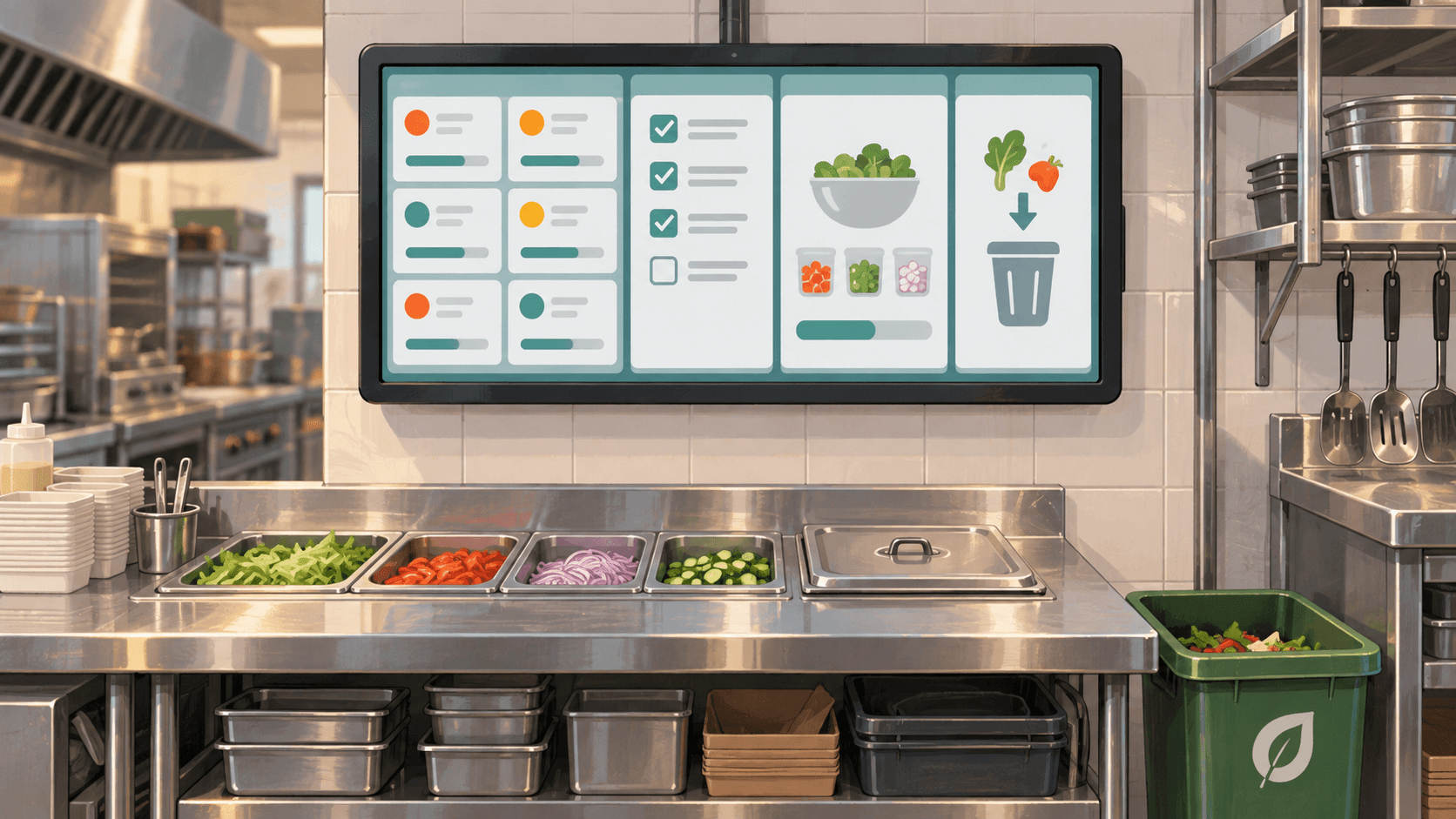
Technology is making off-premise execution cheaper and more accurate. AI ordering, kitchen display systems that prioritize order queuing for multi-channel fulfillment, geofencing that times food production to customer arrival, and route optimization for delivery drivers are all reducing the friction that previously made off-premise less attractive than dining room service from an operator margin perspective.
Real estate development pipelines for new QSR locations are increasingly skewed toward formats built from the ground up for off-premise volume. Industry analyst projections for U.S. QSR real estate development show drive-thru-first and small-footprint concepts outpacing traditional full-format builds in new site approvals.
The dining room is not disappearing entirely. There will always be a segment of occasions and customer types for whom eating in place matters. But the center of gravity of the business has moved. Operators who continue allocating capital and management attention as if the dining room remains central to the model are making a bet against their own revenue data.
The restaurant that does not require you to go inside is the restaurant that is growing. That is where the industry is building, investing, and competing. Everything else is nostalgia.
QSR Pro Staff
The QSR Pro editorial team covers the quick service restaurant industry with in-depth analysis, data-driven reporting, and operator-first perspective.
More from QSR