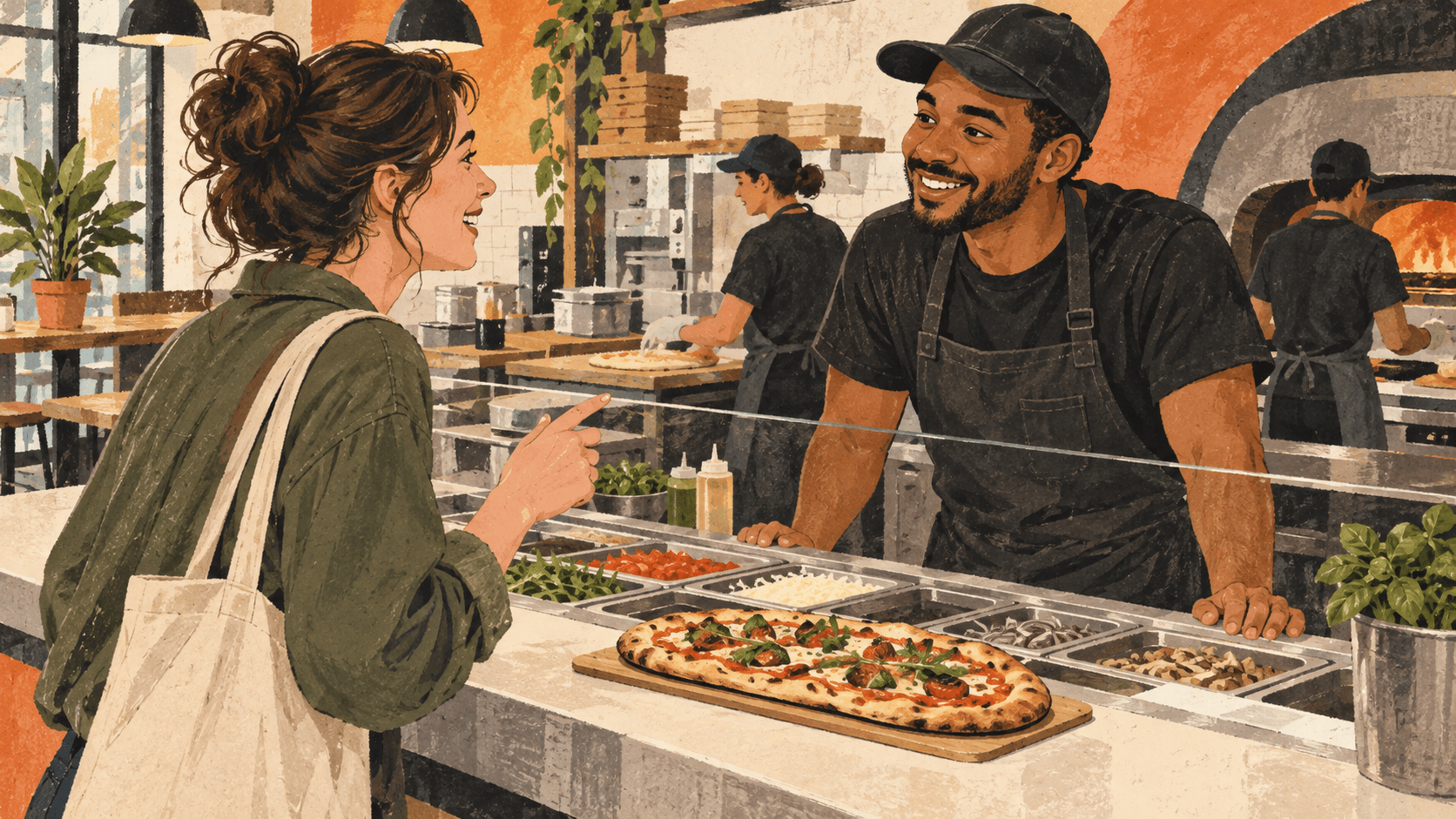
Papa Johns announced on January 11, 2026, that it is the first restaurant brand in the world to deploy Google Cloud's new agentic food ordering solution, built on Gemini Enterprise for Customer Experience. The platform handles ordering across every consumer touchpoint: mobile apps, websites, telephone, kiosks, and in-car systems. It's a significant bet on AI-driven ordering at a chain that is simultaneously restructuring and closing hundreds of locations.
The announcement came at NRF 2026: Retail's Big Show in New York City, where Google Cloud used Papa Johns as its marquee demonstration of what agentic AI can do in foodservice. For an industry watching AI deployments closely, the timing and the partner were notable.
What the Gemini Ordering Agent Actually Does#
The system is more than a voice bot reading back menu items. According to Google Cloud's announcement, the platform uses Gemini's reasoning capabilities to handle what the companies are calling "agentic" ordering, where the AI completes complex, multi-step tasks on behalf of the customer with minimal friction.
Several capabilities distinguish this from earlier chatbot-style ordering tools:
Group ordering at scale. The system can handle complex multi-person orders in natural language, including scenarios like ordering pizza for an entire kids' soccer team. It manages quantities, individual preferences, and dietary needs across a single session without requiring structured inputs or rigid menus of options.
Intelligent Deal Wizard. Rather than requiring customers to know which promotions apply, the system automatically identifies and applies the best-value offer available at checkout. For a chain that has long competed on value and delivery promotions, this reduces the friction of getting customers to take advantage of deals.
Omnichannel deployment. The agent is not a single-channel tool. It operates identically whether a customer is calling by phone, ordering through the app, clicking through the website, using a kiosk in-store, or placing an order through an in-car system. That consistency across channels is harder than it sounds; most chains still run fragmented technology stacks that produce different experiences depending on where a customer initiates an order.
Allergy and preference handling. The system takes natural language inputs about food allergies and preferences, processes them, and applies them across an order. For a chain serving 150 million-plus customers worldwide, reducing allergy-related errors and call center volume around dietary restrictions has operational value beyond the ordering experience itself.
The systemwide rollout is expected to be complete by the end of 2026.
The Contradiction at the Core of This Announcement#
Here is the tension operators and investors should sit with: Papa Johns is making a major AI infrastructure investment at the same moment it is shrinking its physical footprint aggressively.
CEO Todd Penegor, who took the helm in 2024 after leading Wendy's for nearly a decade, has been executing a painful but deliberate restructuring. The chain is closing 200 locations in 2026, part of a broader plan to shutter roughly 300 units by the end of 2027. These are largely underperforming domestic locations, and the closures are framed as a way to stabilize the base, reduce drag on system averages, and set up a healthier unit economics story.
Closing stores while announcing a landmark AI deployment is not as contradictory as it might appear. The Google Cloud platform is systemwide infrastructure, not a store-level capital expenditure in the same category as a kitchen remodel. But the optics are worth acknowledging: Papa Johns is paying to be first on a cutting-edge technology platform while its franchise base is contracting. Franchisees watching the closure announcements and now hearing about enterprise AI investments will have questions about where the capital priorities actually sit.
Penegor has made clear that technology investment is part of the turnaround thesis, not a distraction from it. Reducing labor costs tied to phone order handling, increasing order accuracy, and improving conversion rates on promotions through automated deal application are all levers that improve unit economics at the store level. If the Gemini deployment delivers on those promises, it becomes a tool for making the surviving locations more profitable, not just a headline.
How Papa Johns Compares to the Rest of the Industry#
Papa Johns is not the only chain making major AI ordering moves, but being first on the Google Cloud Gemini platform gives it a specific positioning advantage.
Wendy's has been operating FreshAI, its Google Cloud-powered drive-thru voice ordering system, across a growing number of locations. The company has reported that the system achieves 86% hands-free order completion, handles ordering 22 seconds faster than human-assisted transactions, and maintains high customer satisfaction scores. Wendy's launched the program in 2023 and has been expanding it, providing the kind of performance data that other chains studying AI adoption are watching closely.
Yum Brands announced a partnership with Nvidia in late 2025 to deploy AI across its Taco Bell, Pizza Hut, and KFC locations. Early reported outcomes from that program include 15% faster order processing and 12% higher average ticket sizes, though Yum has not broken down the numbers by brand or geography. The scale of the Yum deployment, across tens of thousands of locations globally, makes it a different kind of experiment than what Papa Johns is attempting.
CKE Restaurants, the parent of Carl's Jr. and Hardee's, has been running a multi-vendor AI drive-thru experiment, testing different providers rather than committing to a single platform. That approach gives CKE flexibility but also means slower systemwide learning compared to chains that have standardized.
Papa Johns sits in an interesting position among these competitors. It does not have drive-thru lanes the way Wendy's or Taco Bell does; its model is delivery and carry-out focused. That means the AI application here is primarily about phone and digital ordering, not window-based voice AI. The emphasis on group ordering and the Deal Wizard reflects the realities of how Papa Johns customers actually interact with the brand: large orders, delivery, and promotion-driven purchasing.
The Agentic Shift in Restaurant Tech#
The word "agentic" in the announcement is worth unpacking for operators who are not deep in AI terminology. Traditional chatbots and voice AI systems follow scripts. They handle recognized commands, ask clarifying questions from a decision tree, and escalate to a human agent when they hit the edge of their capabilities.
Agentic AI systems operate differently. They are given a goal, not a script. When a customer says "I need to order pizzas for my son's soccer team, eight kids, some of them don't eat meat, and I want to use whatever deal is best right now," an agentic system reasons through the request rather than pattern-matching to a fixed response. It determines quantities, filters for dietary restrictions, queries available promotions, applies the best value, and completes the order.
That distinction matters for order complexity. Pizza chains deal with high-customization, high-quantity orders regularly. The system's ability to handle these without requiring structured input from the customer is the actual value proposition. Fewer abandoned orders because the voice bot got confused. Fewer call center escalations. Fewer errors that result in refunds or remakes.
The NRA's 2026 State of the Industry report found that roughly one in four restaurant brands has implemented some form of AI in their operations, up from single digits just two years prior. The technology is moving from pilot to systemwide deployment faster than most operators expected. Brands that are still in the evaluation phase of AI ordering are running out of time to be competitive on this dimension.
What This Means for Franchisees#
Papa Johns franchisees need to watch this rollout carefully for a few reasons.
First, the systemwide deployment target of end-of-2026 is aggressive. That timeline implies the chain has already done enough pilot testing to have confidence in the platform across its diverse real estate and technology environments. Franchisees should be asking for clear implementation timelines, training requirements, and integration specifications with existing POS and delivery management systems. Surprises at rollout are the worst kind of surprises.
Second, the cost structure matters. If the Gemini platform reduces the need for phone order staff, that is a labor cost reduction. But operators need to understand whether the platform licensing cost offsets those savings, exceeds them, or leaves a net improvement. Google Cloud enterprise contracts are not inexpensive. The unit economics of the AI investment need to be transparent.
Third, the Deal Wizard capability has implications for franchisee margin. Automatically applying the best deal for the customer is good for conversion, but franchisees need to understand how promotion application is governed. If the system automatically surfaces national promotions without franchisee input on local offers, that changes how operators manage their own marketing spend.
The bottom line for Papa Johns as an organization is that being first with a major technology platform is a meaningful positioning move in a category where differentiation is increasingly difficult to find. Whether the AI investment helps stabilize the chain's financial performance during what is a genuinely difficult restructuring period depends on execution. Google Cloud and Papa Johns both have incentives to make this work. The system is scheduled to be live across the entire network before the year is out, and by then there will be actual performance data to evaluate.
The industry will be watching.
QSR Pro Staff
The QSR Pro editorial team covers the quick service restaurant industry with in-depth analysis, data-driven reporting, and operator-first perspective.
More from QSR