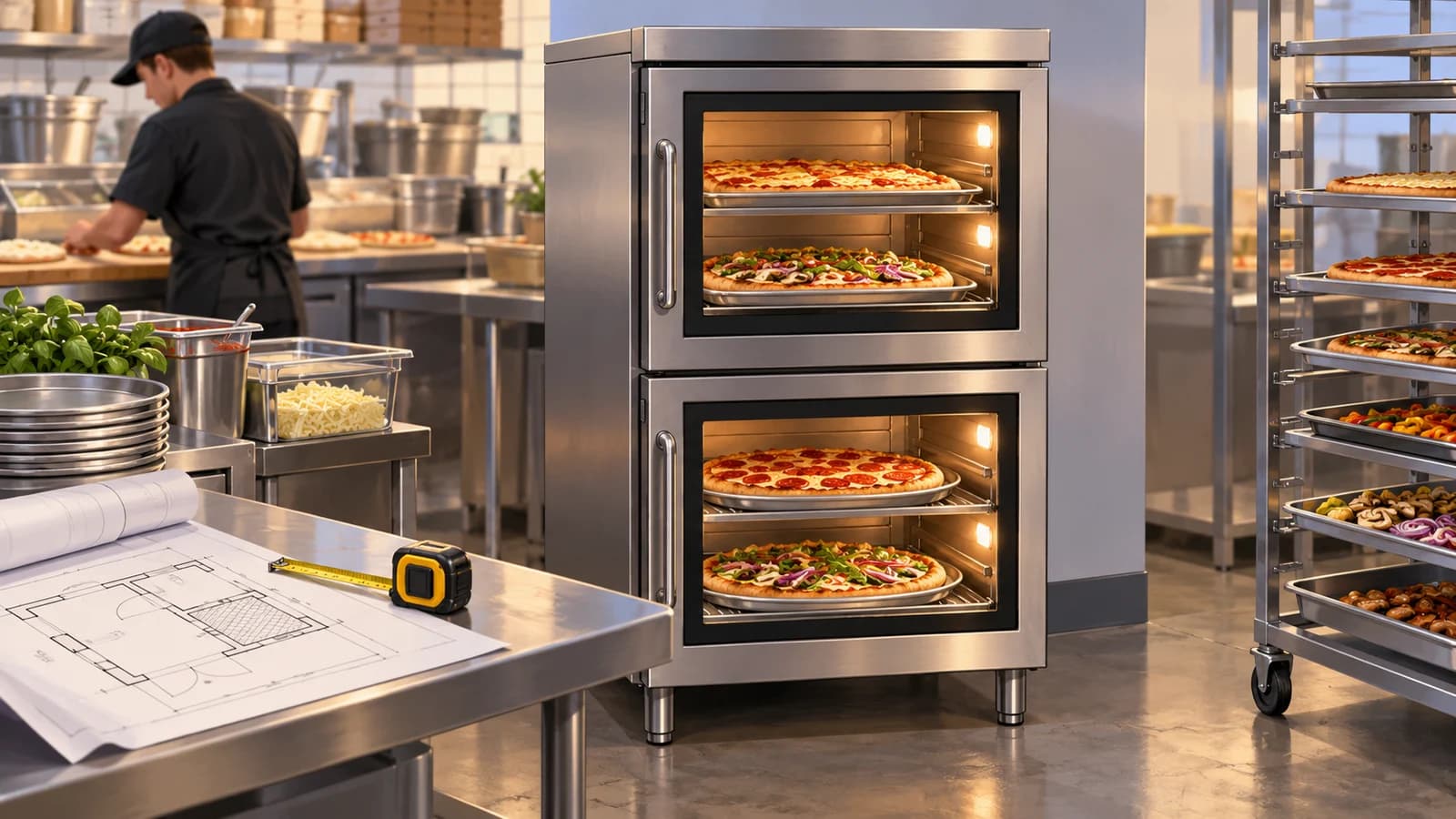
Blodgett says its ImVection oven can run pizza, proteins, baked goods and sides at once, easing a busy kitchen's ticket times. The four cooking chambers fit in a cabinet about two feet wide. When checked October 23, parent company Middleby showed a U.S. starting price of $21,736 for the IMV-4E, before delivery or installation.
For a restaurant with more menu than line space, Blodgett's documents show what a buyer would need to test. The oven has two independent doors, each covering two chambers. Temperature settings, pan sizes, electrical service and cleaning work determine what a store could cook through a rush. Neither Blodgett's documents nor its interview cite measured results from a QSR operator.
Four chambers, one menu plan#
In an October 15 interview, Blodgett's VP of regional sales and director of marketing Stephanie Martin said parallel cooking increases throughput and reduces ticket times. She offered a mix of breakfast sandwiches, pizza, desserts and proteins as an example. Buyers need to test those claims against their own order mix and equipment.
The IMV-4E spec sheet lists chamber settings from 300°F to 525°F and says the unit can maintain up to a 175°F difference between neighboring chambers. The operating manual recommends staying within that difference for best performance and placing hotter chambers above cooler ones. The controls reorder a recipe group's chamber temperatures if they are entered otherwise. Below 400°F the machine uses convection airflow; at 400°F and above it switches to impingement. The unit cannot switch recipe groups while cooking an item in the active group.
A menu trial with busy-hour orders and recipes would show how many items can run in parallel before a temperature change or an occupied chamber slows production. The spec lists a 13-by-18-inch half-sheet pan or a 16-inch pizza pan, with 4.4 inches of usable height above a rack. Those dimensions may suit one concept and constrain another.
What the kitchen has to accommodate#
The manufacturer's specification puts the unit at about 650 pounds. It needs a 24-inch opening when uncrated. Its floor footprint is about 24 by 37 inches. The store listing calls for 22 inches of front clearance, four at each side and two behind. An installer should check those dimensions and service access against the actual site.
The store listing calls for a dedicated 230-volt, three-phase circuit and says the unit must be field-wired. The manufacturer's spec sheet lists 208–240-volt three-phase service and a NEMA 15-50 cord and plug; it also says some units must be hard-wired. Both documents rate the unit at 17.5 kilowatts, but one field on the store page says 11,270 watts. Before a franchisee orders equipment or budgets electrical work, the dealer and electrician need to confirm the exact configuration being supplied.
Blodgett describes the unit as ventless. The spec sheet reports grease-vapor tests for pepperoni pizza and chicken below the stated limit and a UL (KNLZ) listing for ventless operation. Installation must still meet local and national codes. A store should verify the intended menu and site with its code official before treating the absence of a traditional hood as a construction saving.
At close, the manual directs staff to cool the unit, remove the racks and upper and lower jet plates, and keep cleaning liquid out of the catalyst openings. The removable parts can go through a dish machine or soaker. Blodgett's warranty sheet lists one year of parts and labor coverage for ImVection. Its terms start that period at installation or 90 days after shipment, whichever comes first, if the oven is registered; without registration, the period may instead start on the dealer's invoice date.
Middleby's posted price excludes delivery, liftgate service, installation and startup. A franchisee also needs to check whether the oven is on, or can be added to, the brand's approved-equipment list. For a multi-unit owner, the buying comparison is the installed price and a live menu trial at a representative store. The four chambers would have to earn their space by meeting the chain's recipes, local approval and busy-hour demand.
QSR Pro Staff
The QSR Pro editorial team covers the quick service restaurant industry with in-depth analysis, data-driven reporting, and operator-first perspective.
More from QSR