Key Takeaways
- McDonald's ended 2024 with mixed signals.
- Perhaps no single initiative matters more to McDonald's 2026 roadmap than its loyalty program.
- McDonald's has been quietly testing AI-powered voice ordering in drive-thrus for several years, initially partnering with IBM before bringing the technology in-house.
- McDonald's has long struggled with menu bloat.
The Golden Arches Face a Crossroads
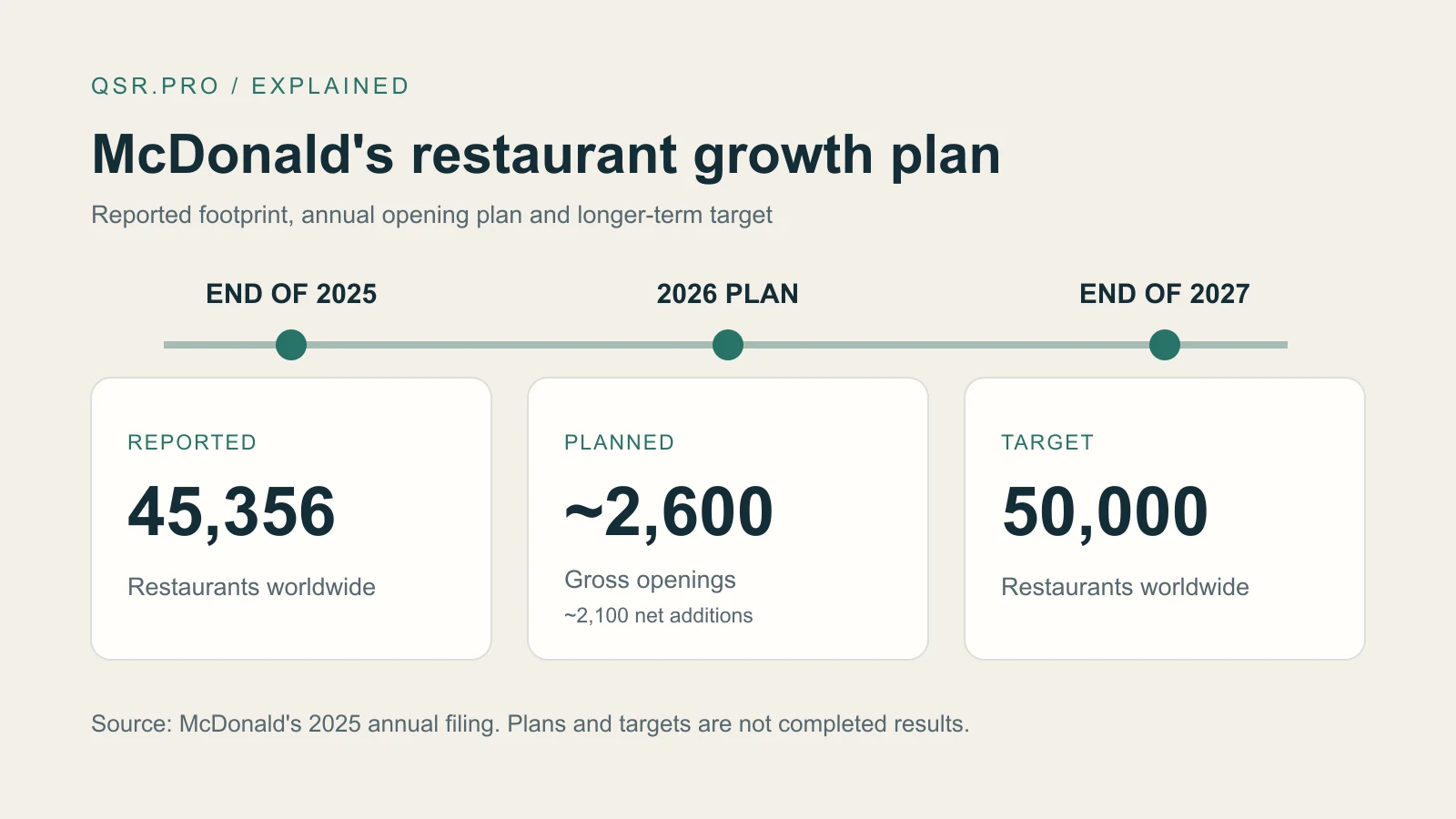
McDonald's ended 2024 with mixed signals. Global systemwide sales topped $130 billion, but U.S. comparable sales dropped 1.4% in Q4. For a company that serves roughly 70 million customers daily across 40,000+ locations worldwide, even small shifts in traffic patterns matter. As the chain enters 2026, its "Accelerating the Arches" strategy is being tested by inflation-weary consumers, competitive pressure from fast-casual chains, and changing expectations around technology and convenience.
CEO Chris Kempczinski has been clear: McDonald's is "playing to win" by focusing on value, menu innovation, and digital engagement. But what does that actually mean in practice? Let's break down the strategic priorities shaping McDonald's over the next 12-24 months.
Digital Infrastructure: The Loyalty Program Arms Race
Perhaps no single initiative matters more to McDonald's 2026 roadmap than its loyalty program. By year-end 2024, the company had 175 million active loyalty users across 60 markets, up 15% year-over-year. Those members generated approximately $30 billion in systemwide sales for the year, with loyalty-driven purchases growing 30% annually.
This isn't just a nice-to-have feature. It's a data goldmine. Every transaction from a loyalty member tells McDonald's what customers order, when they visit, which promotions drive repeat visits, and how price-sensitive different segments are. That data feeds directly into menu planning, marketing spend allocation, and operational decisions at the store level.
The competitive context makes this even more critical. Starbucks has been running a sophisticated rewards program for years. Chick-fil-A's app-driven ordering system has become table stakes in QSR. Taco Bell, Chipotle, and even regional chains are investing heavily in first-party digital platforms to reduce reliance on third-party delivery aggregators and their punishing fee structures.
McDonald's advantage is scale. With 40,000+ locations, the company can offer redemption flexibility that smaller chains can't match. But scale also means complexity. Rolling out app features, integrating point-of-sale systems, and training franchisees across dozens of countries isn't trivial. Expect continued investment here throughout 2026, particularly in personalization features that tailor offers based on individual customer behavior.
The Technology Bet: AI, Automation, and Drive-Thru Efficiency
McDonald's has been quietly testing AI-powered voice ordering in drive-thrus for several years, initially partnering with IBM before bringing the technology in-house. The goal is simple: increase order accuracy, reduce wait times, and free up crew members for food preparation rather than order-taking.
Early results have been mixed. Voice recognition struggles with accents, background noise, and complex customizations. But the company continues to refine the system, and Kempczinski has signaled that technology investments remain a priority. "Our technology investments and ability to scale digital solutions at speed will continue to elevate the McDonald's experience," he said in a recent earnings call.
Beyond voice ordering, automation is creeping into the kitchen. Automated beverage dispensers, fryers with built-in timers and sensors, and even robotic systems for assembling burgers are being tested. None of this is about replacing human workers entirely (though labor cost management is always a factor). It's about consistency and speed, especially during peak hours when drive-thru lines can make or break the customer experience.
The 2026 focus will likely be on scaling what works. McDonald's doesn't need experimental moonshots. It needs proven technology deployed across thousands of locations without disrupting operations. That's a different kind of innovation challenge, more about change management and franchisee buy-in than cutting-edge R&D.
Menu Strategy: Balancing Innovation and Simplification
McDonald's has long struggled with menu bloat. Add too many items and you slow down service. Remove fan favorites and you risk backlash. The company's menu strategy heading into 2026 reflects this tension: targeted innovation in high-margin categories, combined with aggressive value positioning to combat traffic declines.
The chain has leaned into chicken in recent years, recognizing that poultry offers better margins than beef and appeals to health-conscious consumers. Expect continued expansion of chicken-based limited-time offers (LTOs) and potential permanent menu additions if testing goes well.
Breakfast remains a battleground. McDonald's competes with Starbucks, Dunkin', and a wave of fast-casual chains offering premium breakfast sandwiches. The company has tested everything from donut sticks to breakfast bowls, looking for the next McMuffin-level hit that can drive incremental morning traffic.
Value positioning may be the most critical menu element in 2026. With U.S. sales declining in Q4 2024, McDonald's has doubled down on promotional bundles and everyday value platforms to win back price-sensitive customers. The risk is margin compression, franchisees are already operating on thin profit margins, and heavy discounting doesn't help. But losing traffic to competitors who offer perceived better value is worse.
International Expansion: Where Growth Still Lives
While the U.S. market showed weakness in late 2024, McDonald's international segments tell a different story. The International Developmental Licensed Markets segment grew comparable sales 4.1% in Q4 2024. These markets, often operated by local franchisees or master franchise agreements, represent McDonald's highest growth opportunity.
China continues to be a focal point. The country's middle class is expanding, urbanization is accelerating, and QSR penetration remains lower than in Western markets. McDonald's has committed to opening thousands of new locations in China over the next decade, often in smaller cities where brand recognition is still being built.
India, the Middle East, and parts of Southeast Asia also present growth opportunities. But international expansion comes with risks: currency fluctuation, geopolitical instability, and the challenge of adapting the menu to local tastes without losing operational efficiency.
The 2026 strategy won't involve radical geographic pivots. McDonald's is already everywhere that matters. Instead, expect incremental growth in underpenetrated markets and refranchising efforts in mature markets where the company can shift capital-intensive operations to franchisees while retaining royalty income.
The Franchisee Relationship: Tension Under the Surface
McDonald's operates primarily as a franchisor, with roughly 95% of locations owned and operated by franchisees. This model generates high-margin royalty income (around 4-5% of sales) and rental income from company-owned properties leased to franchisees. But it also means the company's growth depends on franchisee health.
And franchisees are feeling the squeeze. Labor costs have risen. Food costs spiked during the inflationary period of 2021-2023. Equipment upgrades for technology initiatives require capital investment. And now McDonald's corporate is pushing heavy value promotions that compress margins further.
The National Owners Association, an independent advocacy group for U.S. franchisees, has occasionally clashed with corporate over these issues. While McDonald's maintains generally strong franchisee relations compared to some competitors, the tension is real. If franchisees don't see a clear path to profitability, they'll resist corporate initiatives, no matter how strategic they sound in a Chicago boardroom.
Expect McDonald's to walk a fine line in 2026: pushing growth initiatives that require franchisee investment while also providing support (co-op advertising dollars, equipment financing, operational playbooks) to keep operators on board.
Real Estate and Remodeling: The Ongoing Refresh
McDonald's owns a significant amount of valuable real estate, particularly in the U.S. and Western Europe. The company has been slowly remodeling older locations with updated exteriors, modernized interiors, and features like digital menu boards and dual-lane drive-thrus.
These remodels aren't cheap. A full renovation can cost $500,000 to $1 million or more, depending on the market. But the company has data showing that remodeled locations see sales lifts, both from improved customer experience and better operational efficiency.
In 2026, the remodel pipeline will continue. McDonald's wants its physical footprint to match the digital-forward, tech-enabled brand image it's cultivating. That means more touchscreen kiosks, mobile order pickup areas, and design elements that signal "modern" rather than "nostalgic."
At the same time, the company is experimenting with smaller-footprint locations optimized for delivery and mobile pickup, particularly in urban markets where real estate costs make traditional standalone buildings economically challenging. These formats represent a potential growth vector in dense, high-income areas where McDonald's has historically underperformed against fast-casual competitors.
Competitive Threats and Market Share Dynamics
McDonald's dominance in QSR is undeniable, but the competitive landscape is tougher than ever. Chick-fil-A generates higher per-store sales despite being closed on Sundays. Chipotle has cultivated a premium brand perception that allows it to charge higher prices without losing traffic. Shake Shack, Sweetgreen, and other fast-casual chains are pulling away younger, affluent customers who view McDonald's as a fallback option rather than a destination.
The company's response has been to sharpen its positioning: fast, affordable, and convenient, with enough menu variety to appeal to families, value seekers, and impulse purchasers. But that positioning doesn't win loyalty in the way that Chick-fil-A's service culture or Chipotle's ingredient storytelling does.
McDonald's 2026 challenge is existential: can it maintain its scale advantages and operational efficiency while also delivering the kind of experience that builds emotional connection with customers? Or will it increasingly become a commodity player, competing primarily on price and convenience while ceding premium market share to competitors?
Sustainability and ESG: The Quiet Transformation
Sustainability hasn't been a major headline driver for McDonald's, but the company is making significant moves behind the scenes. Commitments around sustainable beef sourcing, reducing plastic waste, and lowering greenhouse gas emissions are all part of the long-term strategy.
These initiatives matter for several reasons. Younger consumers increasingly factor environmental impact into purchasing decisions. Institutional investors are demanding better ESG performance. And regulatory pressure around single-use plastics and carbon emissions is intensifying in markets like the EU.
In 2026, expect McDonald's to continue piloting initiatives like reusable packaging trials, renewable energy investments for company-operated restaurants, and supply chain transparency efforts. These moves won't drive short-term sales, but they mitigate long-term risk and align with where stakeholder expectations are heading.
What Success Looks Like in 2026
If McDonald's executes well over the next 12-24 months, what does success look like? A few key indicators:
- U.S. comparable sales return to positive territory, driven by a combination of traffic growth and strategic price increases.
- Loyalty program engagement continues to grow, with active users exceeding 200 million and loyalty-driven sales surpassing $40 billion annually.
- Digital and delivery sales increase as a percentage of total revenue, reducing reliance on in-store transactions and building higher-margin channels.
- International growth accelerates, particularly in China and other emerging markets, offsetting slower growth in mature Western markets.
- Franchisee profitability stabilizes, reducing tension and creating alignment around corporate initiatives.
None of this is guaranteed. Economic conditions could deteriorate. A food safety incident could erase years of brand-building. A competitor could introduce a disruptive innovation that forces McDonald's to play catch-up.
But the company has navigated challenges before. It survived the rise of Chipotle, the backlash against fast food, and the existential crisis of the 2000s when same-store sales were declining and the brand felt stuck. It did so by returning to operational fundamentals, investing in the customer experience, and leveraging its unmatched scale.
The 2026 strategy is more of the same: incremental improvements executed at massive scale, with enough flexibility to adapt when things don't go as planned. Not revolutionary. Not inspiring. But probably effective.
The Bottom Line
McDonald's isn't trying to reinvent itself. It's trying to stay relevant in a market that has moved on from the idea that fast food is a monolithic category. The company is investing in technology, leaning into value, expanding internationally, and managing the complex dynamics of a franchise system that spans continents.
Will it work? The early signs from 2025 are encouraging. Q2 and Q3 both showed global comparable sales growth, suggesting the strategy is gaining traction. But one or two quarters don't make a trend, especially in a business as large and complex as McDonald's.
What's clear is that the Golden Arches aren't going anywhere. Whether they're growing or just treading water will depend on execution, franchisee alignment, and a bit of luck. In 2026, McDonald's will still be the world's biggest restaurant chain. Whether it's the most successful one is a harder question to answer.
David Park
QSR Pro staff writer covering competitive dynamics, market trends, and emerging QSR concepts. Tracks chain performance and strategic shifts across the industry.
More from David