Portillo's Strategic Reset: How a Chicago Icon Choked on Its Own Expansion
Dick Portillo opened his first hot dog stand in Villa Park, Illinois in 1963 with $1,100 and a trailer. Six decades later, the company bearing his name raised $466 million in one of the most celebrated restaurant IPOs of 2021. By March 2026, the stock trades near $5.50 per share, down from its November 2021 peak of $54.22. That is a 90% collapse in roughly four years.
The wreckage is not the result of a bad product. Anyone who has eaten a Chicago-style hot dog or an Italian beef sandwich at a Portillo's knows the food works. The wreckage is the result of a company that confused cult status with portability, that confused enthusiasm for a concept with the ability to execute that concept at scale in unfamiliar markets. It is a story as old as the franchise industry itself, dressed in new clothes, financed with public money.
Every regional operator with a loyal following and a growth equity deck should read this carefully.
The IPO and the 920-Location Promise#
When Portillo's went public in October 2021, it had roughly 38 locations, almost all of them in Illinois. The IPO price of $20 per share gave the company a valuation that priced in extraordinary growth expectations. Management laid out an ambitious target: 920 locations over 20 years, a 24-fold increase from the pre-IPO footprint.
Wall Street loved it. The stock opened at $30.52 on its first day and kept climbing, hitting $54.22 before the end of November 2021. At that peak, Portillo's was valued at roughly $2.8 billion on roughly $600 million in annual revenue. The multiple implied perfection.
The core thesis was compelling on paper. Portillo's average unit volume far exceeded most fast casual competitors. The Chicago flagship on South Loop does approximately $20 million per year. The company average sat around $8.7 million per unit, still exceptional by industry standards. If Portillo's could replicate those economics in new markets, the math supported aggressive expansion.
The problem was the assumption buried inside that math: that the economics would replicate.
Texas: Where the Expansion Story Broke#
The most consequential test of Portillo's national ambitions was Texas. Beginning in early 2023, the company moved aggressively into the state, opening 16 locations. The pace was fast. The proximity between some units created internal cannibalization before individual stores had time to build their own customer base. Texas consumers had no generational connection to the brand, no nostalgia for the Italian beef, no reason to seek out a restaurant they had never heard of.
Portillo's operates large-format restaurants. The traditional build runs approximately 7,700 square feet and seats a substantial dining room alongside a drive-through. Construction and pre-opening costs reflect that footprint. In Chicago, where Portillo's has been a cultural institution for decades, those costs are recoverable. Customers come because they already know and love the brand. In Texas, the company was spending as if it had the same built-in demand it had at home.
It did not.
The financial results told the story clearly. In its most recent reported quarter before the strategic reset, Portillo's saw revenues increase just 1.8% year over year. Net income dropped from $8.8 million to under $1 million. Same-store sales were under pressure. New units were not ramping the way the IPO model assumed they would.
Leadership Failure and Activist Pressure#
By mid-2024, Engaged Capital, an activist investment firm, had accumulated approximately 10% of Portillo's outstanding shares. Activist accumulation at that level is not a passive signal. It is a declaration that the current leadership is destroying value and that change is coming one way or another.
CEO Michael Osanloo, who had led Portillo's since 2018 and guided it through the IPO, resigned under pressure in September 2024. His departure coincided with the company beginning a formal strategic review.
Engaged Capital secured a board seat as part of its engagement. The firm subsequently reduced its stake to approximately 2% by October 2025, a common pattern for activist investors once they have extracted concessions and installed board-level oversight. The damage to the stock, however, was not reversible by a board seat alone. The company needed operational change, not just governance change.
Brett Patterson and the New Direction#
In February 2026, Portillo's named Brett Patterson as its new CEO. Patterson brings a background built almost entirely in casual dining: stints at Ruby Tuesday, Outback Steakhouse, Darden Restaurants, and most recently Miller's Ale House, where he oversaw 116 locations.
The casual dining background is notable because it suggests the board is prioritizing operational discipline over growth evangelism. Patterson is not a person brought in to sell a story to Wall Street. He is a person brought in to fix the economics.
The strategic pivot Patterson inherited or accelerated has three visible components.
First, the pace of new openings is being cut significantly. Portillo's is reducing its 2026 openings from 12 units to 8, with a similar reduction planned for 2027. For a company that once promised 920 locations, pulling back to 8 new restaurants per year is a dramatic deceleration. It signals that the priority has shifted from growth to getting existing units profitable.
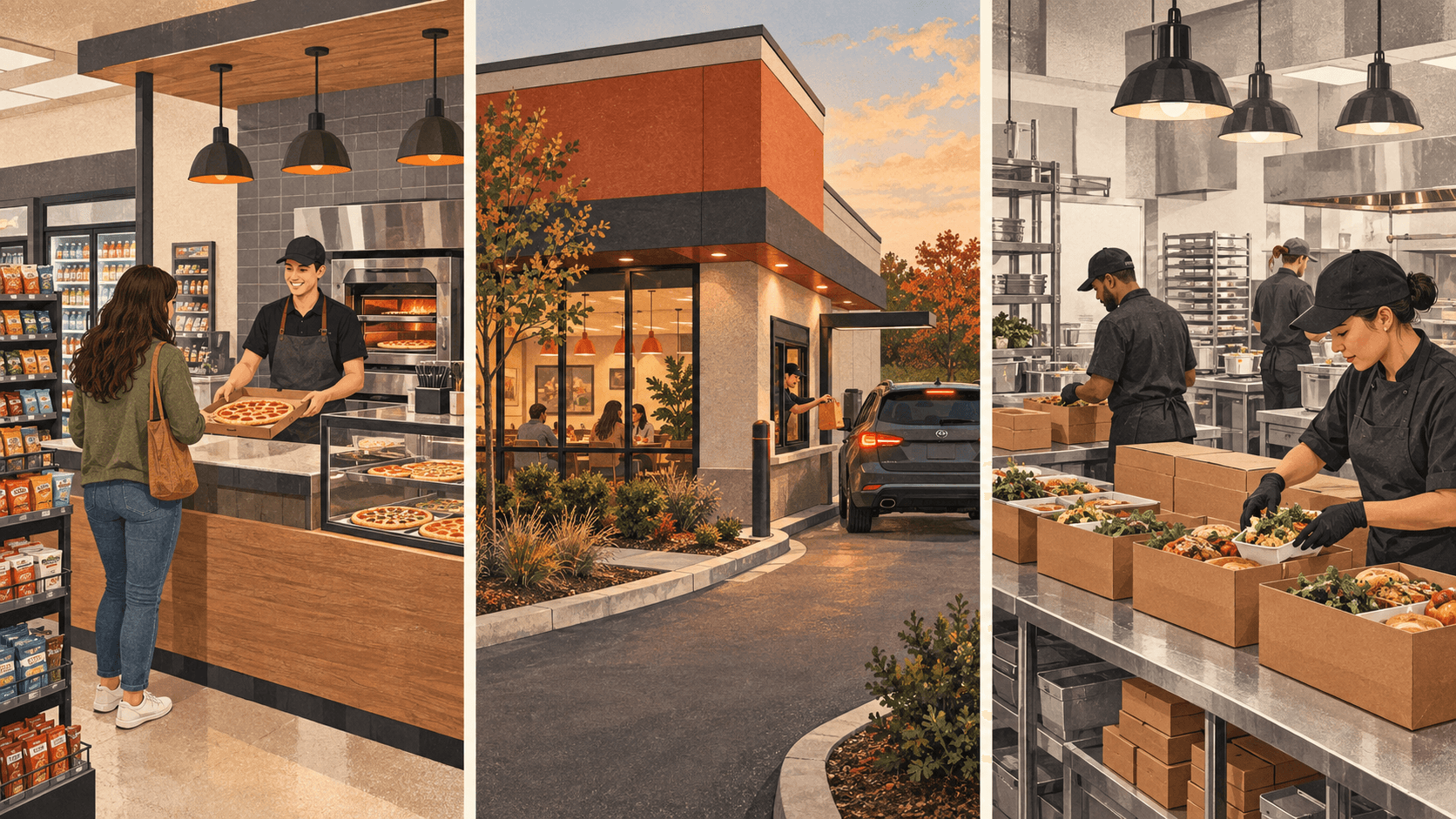
Second, the company has developed a new smaller-format prototype called "Restaurant of the Future 1.0." The new design comes in at approximately 6,200 square feet, roughly 20% smaller than prior builds, and targets a construction cost under $5 million. Reducing the physical footprint and construction cost directly addresses the unit economics problem that plagued Texas expansion. Lower invested capital means a lower sales threshold for acceptable returns.
Third, and potentially most significant for the long-term brand architecture, Portillo's has introduced a format called Portillo's Pick Up. The concept is drive-through and carry-out only, sized at under 4,000 square feet. That is roughly half the footprint of a traditional Portillo's. No dining room, no table service, no large real estate footprint.
The Pick Up format makes intuitive sense for markets where the Portillo's name does not yet carry the gravitational pull it has in Chicago. Lower capital deployment, lower fixed cost structure, lower break-even volume requirements. If a Pick Up unit underperforms expectations, the financial damage is manageable. If the same unit had been built to traditional specs, the damage can threaten the entire market-entry strategy.
What Loyalty Programs Can and Cannot Fix#
In spring 2025, Portillo's launched a customer loyalty program, entering the digital engagement space that most major chains built out years earlier. The timing tells its own story: loyalty infrastructure should precede national expansion, not lag it. Understanding customer behavior, purchase frequency, and preferences across markets is information you need before you open your sixteenth Texas location, not after.
The loyalty program gives Portillo's a tool it previously lacked for building repeat visits in cold markets. But data and points do not substitute for brand familiarity. Chicago customers go to Portillo's because they grew up there. Texas customers need to be taught why it matters, and a punch card alone cannot do that teaching.
Portillo's also ran a breakfast pilot in 2025 that failed and was discontinued. Breakfast expansion is a classic trap for chains trying to boost average unit volumes without solving the underlying brand equity problem in new markets. If dinner traffic is soft because consumers are not yet aware of your brand, adding a morning daypart that requires entirely different operational muscle does not solve anything. It adds cost and complexity to an already strained operation.
The Brand Portability Problem#
William Blair analyst Sharon Zackfia captured the central issue with precision: "Portillo's is a hometown hero. But 'iconic' is a dangerous term to use outside of the Chicago area."
This is the core tension for any regional chain attempting a national rollout. Cult status is real. It is economically valuable. Fans are loyal, frequency is high, average check is strong. But cult status is rooted in cultural context. Portillo's resonates in Chicago because Chicago is where the story was written. The restaurant is woven into the social fabric of the region, tied to Cubs games and family dinners and post-game celebrations. That story does not pack up and travel.
Compare the Portillo's experience to chains that successfully expanded cult status nationally. Whataburger took generations to move beyond Texas and did so by letting local mythology do the heavy lifting before aggressive expansion. In-N-Out has been one of the most disciplined expansion stories in QSR history, refusing to stretch the supply chain or dilute the brand even as the financial upside of faster growth was obvious. Chick-fil-A spent decades getting the model right before accelerating.
Portillo's attempted to compress that timeline using IPO capital, and the market made its judgment.
What the Unit Economics Actually Required#
The traditional Portillo's model, at $8.7 million in average unit volume and a traditional restaurant footprint with associated construction costs, requires genuine brand pull to generate acceptable returns. In Chicago, that pull exists and the model works. Outside Chicago, the math required either matching that volume or reducing the cost structure.
The company tried to match the volume first and found it could not. Now it is reducing the cost structure through smaller formats. This is the right sequence for diagnosis but the wrong sequence for execution. A more capital-efficient format should have preceded the Texas land rush, not followed the Texas disappointment.
The new "Restaurant of the Future 1.0" at under $5 million construction cost represents a meaningfully different economic profile. If a Pick Up unit can be built for even less, Portillo's gains the ability to test markets without betting the balance sheet on each one. This kind of optionality is what franchise-ready unit economics look like. The tragedy is that the company needed a 90% stock decline and a CEO departure to get there.
The Road Back#
Patterson has a credible toolkit. Slower growth buys time for existing units to mature and for the brand to build organic awareness in markets like Texas. Smaller formats reduce the financial risk of each incremental opening. The loyalty program creates a feedback loop that better-run chains have had for years.
But the stock price reflects a market that has heard the growth story and watched it fail. Rebuilding credibility with investors requires sustained execution, not a new narrative. Same-store sales improvement at existing Texas units would be more valuable than any rebranding exercise. Demonstrating that the Pick Up format actually delivers the unit economics its smaller footprint promises would be meaningful proof.
Portillo's still has genuinely exceptional food and one of the most loyal customer bases in regional dining. Those are real assets. The South Loop flagship at $20 million per year is proof that the concept, in the right market with the right consumer base, is extraordinary.
The question for Patterson and the board is whether the company can build enough brand equity in enough non-Chicago markets to justify its existence as a national chain. The alternative is a more honest footprint: concentrate where the brand works, optimize those units, generate cash, and grow only when genuine demand exists rather than because the IPO deck promised 920 locations.
For operators watching from the outside, the lesson is not that Portillo's failed because of operational incompetence. It is that brand strength in one geography is not a license to print money in another. Unit economics that work in your home market need to be tested, not assumed. And the capital structure you build around expansion expectations becomes a cage when those expectations prove wrong.
The $466 million raised in 2021 gave Portillo's the resources to find out, at considerable cost, exactly where its brand ends.
QSR Pro Staff
The QSR Pro editorial team covers the quick service restaurant industry with in-depth analysis, data-driven reporting, and operator-first perspective.
More from QSR