The restaurant industry employs more Americans than almost any other sector. It also cannot find enough of them.
Six years after the pandemic reshuffled the workforce, the National Restaurant Association estimates the industry still needs more than 200,000 additional workers just to reach pre-pandemic staffing levels. That number is not a temporary shortfall waiting for the labor market to normalize. It reflects structural changes to who works in restaurants, who is available to work in restaurants, and what those workers now expect in exchange for their labor. The forces driving the gap are accelerating in 2026, not easing.
For QSR operators, this is not an HR problem. It is a P&L problem. Labor and food combined account for roughly 70 percent of total restaurant expenses. Labor alone typically runs 25 to 35 percent of revenue at QSR locations, according to National Restaurant Association benchmarks. When you cannot hire at a price that preserves your margins, or when you can hire but cannot keep people, every other operational lever gets harder to pull.
Why the Gap Is Structural, Not Cyclical#
The instinct in restaurant operations is to treat labor shortages as a tide that goes out and comes back in. Raise wages a bit, improve scheduling, and the applicants return. That approach has always worked before.
It is not working the same way now, because the shortage is being driven by structural forces that wage adjustments alone cannot fix.
The population math. The Bureau of Labor Statistics projects that the U.S. labor force participation rate among workers aged 16 to 24, the demographic QSR operators have historically depended on, will continue declining through the late 2020s. The share of teenagers working has fallen from more than 50 percent in the late 1970s to around 35 percent today. Some of that is educational enrollment. Some is cultural. None of it is reversing quickly.
The pandemic exit. The Bureau of Labor Statistics' Current Population Survey tracks workers who left the labor force entirely during 2020 and 2021 and did not return. An estimated 2 million workers who had concentrated experience in food service shifted to adjacent sectors and stayed there. Healthcare, logistics, and home services absorbed many of them. These are workers who learned they had transferable skills and left the restaurant industry for environments they found more predictable.
Projected growth versus actual need. The BLS does project that food preparation and serving-related occupations will add roughly 500,000 jobs through 2032. That number sounds encouraging until you run it against the 200,000-unit deficit that already exists, the industry's estimated need for 15 million workers to support projected revenue growth, and the fact that replacement demand, filling positions vacated by turnover, accounts for the vast majority of projected job openings. The industry is running hard to stay in place.
The Wage Floor Has Risen, and It Will Keep Rising#
Twenty-two states raised minimum wages in 2026. Seventeen states now have minimum wages at or above $15 per hour. California's fast food sector operates under a $20 per hour floor established by AB 1228, with a state Fast Food Council empowered to adjust that rate annually.
Higher wage floors have helped with recruitment in some markets. They have not solved the supply problem, because the wage increases are happening everywhere simultaneously, reducing the competitive advantage any single employer gains by raising wages to the new floor. When the floor rises, everyone moves up together, and relative positioning stays the same.
The costs, however, do not stay the same. A QSR unit running 20 hourly employees at an average of 30 hours per week faces an annual labor bill that grows by roughly $50,000 for every dollar-per-hour increase in the wage floor, once payroll taxes are included. Michigan's minimum wage jumped from $10.33 to $13.73 on January 1, 2026, a 33 percent single-year increase. Hawaii moved from $14.00 to $16.00. For operators in those states who had budgeted based on prior wage levels, the 2026 unit P&L looks materially different than projected.
The wage spiral creates a secondary problem: compression. When entry-level crew wages increase sharply, the differential between crew pay and shift supervisor or assistant manager pay collapses. A crew member making $20 per hour in California does not have a strong financial incentive to take on the additional responsibility of a shift lead role at $21 or $22 per hour. Operators who have not rebuilt their entire pay band structure are finding the promotion pipeline seizing up.
Immigration Enforcement Is Tightening the Supply Side#
The restaurant industry has long drawn a significant portion of its hourly workforce from immigrant communities. The 2024 Culinary Institute of America and Cornell survey found that approximately 30 percent of restaurant employees nationwide are foreign-born, with concentrations well above that figure in metro markets like Los Angeles, Miami, New York, and Chicago.
The current administration's enforcement posture on immigration is materially tighter than its predecessor's. Increased worksite enforcement actions, expanded use of E-Verify, changes to visa processing timelines, and elevated deportation activity in key metro areas have already begun reducing workforce availability in markets with high concentrations of restaurant employment.
This is not a projection. Operators in Miami, Los Angeles, and the Rio Grande Valley are reporting it directly. The National Restaurant Association flagged workforce availability as a top-five concern for 2026 in its State of the Restaurant Industry report, noting that immigration policy changes were among the primary sources of uncertainty operators cited.
The supply-side impact of tighter enforcement does not show up cleanly in national employment statistics. Workers who reduce their labor market participation due to enforcement risk do not register as unemployed. They simply become unavailable. For operators in affected markets, the practical effect is fewer applicants responding to job postings, particularly in kitchen and prep roles that have historically had high concentrations of immigrant workers.
What Gen Z Actually Wants, and What QSR Offers#
The generational dimension of the restaurant labor crisis is real, though it is more nuanced than most operators acknowledge. Gen Z, defined as workers born between 1997 and 2012, now represents the largest cohort entering the workforce. They are also the cohort that QSR operators need most, and the one hardest to retain.
The gap is not primarily about wages. Research from Deloitte's 2025 Gen Z and Millennial Survey and separate work by the Society for Human Resource Management points to a consistent set of expectations: schedule predictability, meaningful advancement paths, psychological safety in the workplace, and alignment with employer values.
QSR operations have historically been weak on all four dimensions.
Schedule predictability is the most tractable. Just-in-time scheduling, where workers learn their schedules one to three days in advance, is common in QSR and actively harmful for retention among Gen Z workers who are balancing school, second jobs, or caregiving responsibilities. Research published in the Journal of Policy Analysis and Management found that schedule predictability interventions reduced turnover by 11 to 14 percent at pilot locations. Cities including San Francisco, Chicago, and New York now mandate advance scheduling notice under fair workweek ordinances, but most QSR operators have not applied those standards nationally.
Advancement pathways are an area where QSR actually has a genuine story to tell, but rarely tells it effectively. Chick-fil-A's operator model, McDonald's Archways to Opportunity program, Chipotle's Cultivate career development program, and similar initiatives at larger chains provide real pathways from crew to management to franchise ownership. The gap is execution and communication. Operators who actively mentor crew toward promotion, not just post about it in the break room, retain people at meaningfully higher rates.
Psychological safety and values alignment are harder to operationalize. Gen Z workers who perceive their workplace as disrespectful, chaotic, or misaligned with their values leave quickly and do not recommend it to peers. In an industry where word-of-mouth in social networks matters for recruiting, this creates a compounding disadvantage for locations with poor cultures.
The industry's turnover statistics reflect the mismatch. QSR turnover has historically run 100 to 150 percent annually at the crew level. The Cornell Center for Hospitality Research estimates the cost to replace a single hourly restaurant employee at $1,500 to $3,500, accounting for recruiting, hiring, and training. For a 30-person unit turning over 120 percent annually, that is 36 replacement cycles at an average cost of $2,500 each: $90,000 per year in turnover-related costs, before a single hour of service disruption is counted.
How Chains Are Responding#
The most effective operator responses to the labor crisis are systemic, not reactive. The operators absorbing labor pressure best are running a different operating model than the ones struggling, not just paying more.
Automation, deployed with precision. Self-service kiosks are now present in more than 80 percent of McDonald's U.S. locations and expanding rapidly across Burger King, Wendy's, and most major QSR brands. The operational benefit is not just labor reduction. Kiosks handle order accuracy with fewer errors than counter staff under pressure, and the average check on kiosk orders consistently runs 15 to 30 percent higher than counter-placed orders due to upsell prompts. The labor savings are real, typically one to two positions per shift, but the revenue lift is what makes the investment math work at most locations.
Beyond kiosks, kitchen automation is advancing. Miso Robotics' Flippy system is deployed in White Castle locations for fry station operations. Chipotle and Cava have both piloted automated assembly systems for high-volume throughput. Yum Brands has been deploying voice AI at drive-through lanes across Taco Bell and KFC locations, with results showing meaningful reduction in order time and improved accuracy rates. These technologies do not eliminate the kitchen workforce; they reduce the number of people needed to produce the same volume.
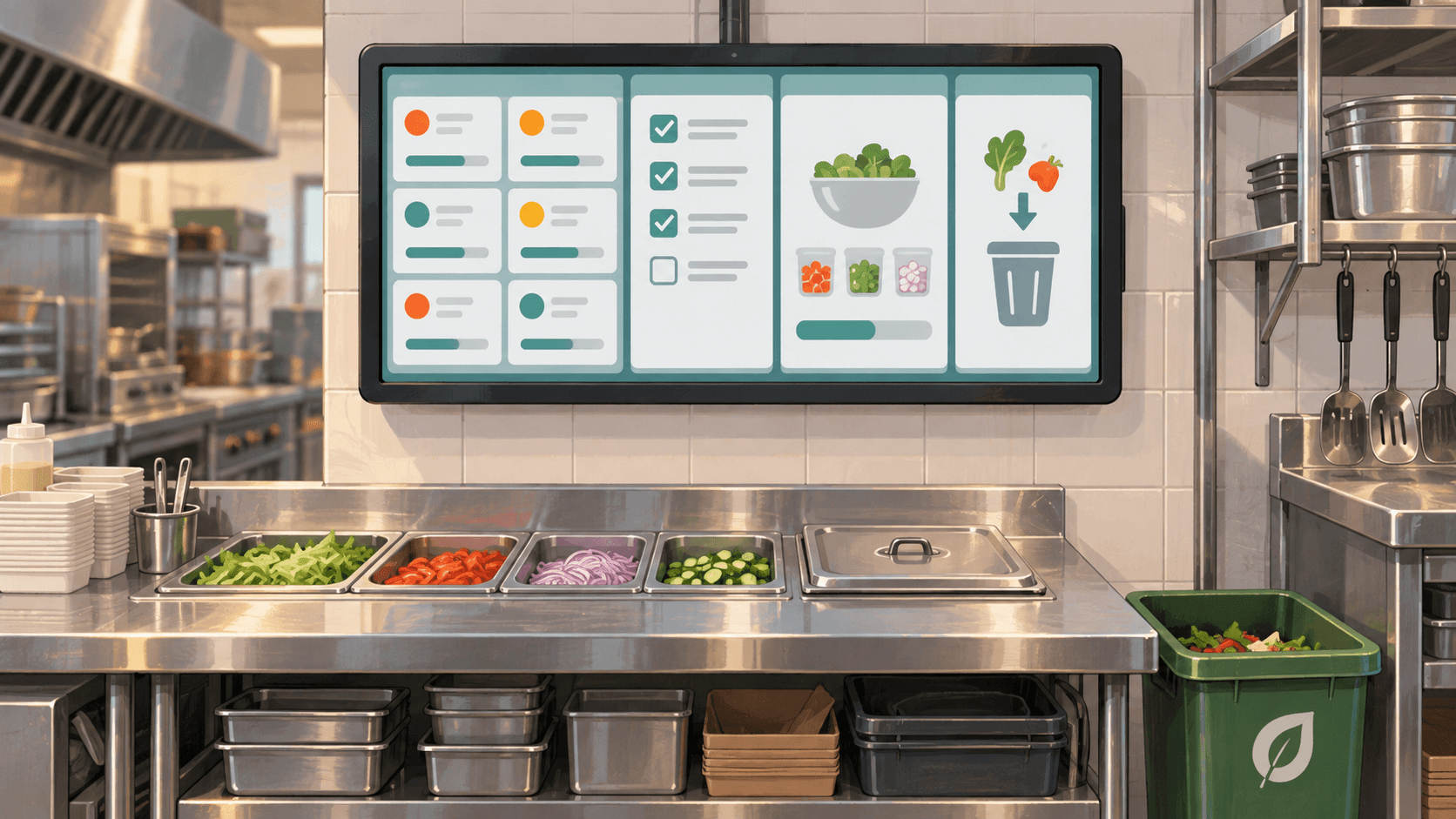
Labor scheduling as a financial discipline. The operators outperforming on labor costs are treating scheduling software as a revenue management tool, not a compliance tool. Systems from HotSchedules, Fourth, and similar vendors can integrate directly with POS transaction data to forecast demand by daypart and set staffing budgets in dollars of labor per dollar of sales, not just employee count. Operators using these systems report labor cost reductions of 1 to 3 percentage points of revenue compared to operators using manual scheduling, according to case studies published by the National Restaurant Association Solutions group.
That 1 to 3 point improvement is meaningful at QSR margins. A unit running $2 million in annual revenue at 5 percent net margin earns $100,000. A 2-point labor reduction represents $40,000 of that total, or 40 percent of net income, through better scheduling alone.
Retention over recruitment. Several chains have explicitly shifted their workforce strategy away from high-volume recruiting toward targeted retention investment. Raising wages modestly above the new legal floor, providing guaranteed minimum hours, offering early pay access through platforms like Branch or DailyPay, and investing in recognition programs have all shown retention impact in documented operator case studies. The math is straightforward: keeping a $20-per-hour crew member for 18 months instead of 6 months saves two replacement cycles, or roughly $5,000, enough to fund a meaningful raise for the same employee.
Format rationalization. Drive-through-only, double drive-through, and digital-order-priority formats require fewer front-of-house labor hours than full dining room operations. Several chains are accelerating unit conversion to these formats in high-wage markets. McDonald's CosMc's spinoff and its small-format digital-first model reflect exactly this calculus. The trade-off is capital cost for the conversion, but at $17 to $20-per-hour labor floors, the payback math changes quickly.
The Operator Math: Where Labor Costs Are Heading#
The question operators need to model now is not where labor costs are today. It is where they land in 2027 and 2028, and whether the current unit economic model survives that trajectory.
A base-case scenario for a unit in a state at $15 per hour today, with scheduled annual CPI-linked increases:
- 2026: $15.00 per hour average starting wage
- 2027: $15.60 to $16.00, based on CPI trajectory at 4 to 5 percent
- 2028: $16.25 to $16.75, continuing the same trajectory
For a unit with 20 hourly employees at 30 hours per week, that is an additional $50,000 to $70,000 in cumulative labor cost by 2028 compared to 2025 baselines, not counting the compression-driven increases at supervisor and manager levels that typically follow.
On a $2 million revenue unit, labor at 30 percent is $600,000. Holding revenue flat, that same unit at a $16.75 wage floor is looking at labor costs of $640,000 to $660,000. The 3-point margin compression needs to come from somewhere: pricing, technology, or format.
California operators are already running those numbers at $20 per hour. The rest of the country is three to five years behind them, which means there is a window to observe what works and implement it before the same math arrives.
What the Data Actually Shows About Automation and Employment#
The narrative that automation eliminates restaurant jobs has been running for a decade, and the aggregate employment numbers do not support it. Total restaurant employment in the U.S. as of late 2025 remained within 2 percent of its 2019 peak, according to BLS data. Kiosk deployments at scale began in 2017. Employment has not collapsed.
What automation changes is the skill composition and the volume of transactions per employee. A McDonald's location handling 1,500 transactions per day with 25 employees and kiosk technology is running more efficiently than the same location handling 1,200 transactions per day with 30 employees a decade ago. The jobs look different, the throughput is higher, and the revenue per labor hour has improved.
The more honest framing for operators is that automation is not a workforce-elimination strategy. It is a productivity strategy that allows the existing workforce to handle more volume at current headcount, or equivalent volume with lower headcount, in an environment where finding and keeping workers is increasingly difficult and expensive.
That framing matters for how operators communicate with their teams. Employees who understand that kiosk deployments are keeping the unit's margins viable, and therefore keeping their jobs, respond differently than employees told nothing until the kiosk shows up in the lobby.
The Path Forward for Operators#
The labor cliff is not a crisis to be solved and put behind you. It is the new operating environment. The chains and operators that will navigate it best share a set of characteristics.
They treat workforce strategy as a C-suite issue, not an HR function. They have modeled their unit economics at wage floors that are $2 to $5 above today's rates and built a plan for how they survive at those levels. They have invested in scheduling technology and automation not as cost-cutting emergency responses but as standard operating infrastructure. They have rebuilt their internal compensation bands to maintain meaningful differentials between crew, shift supervisor, and management roles. And they have accepted that turnover at 100 percent annually is not inevitable; it is a system output they can influence.
The 200,000-worker gap the National Restaurant Association cites is a net number. It does not mean the industry cannot function. It means the industry is functioning at reduced capacity, accepting service limitations, reduced operating hours, and closed dayparts that it would not have accepted five years ago. The operators who have treated that as a permanent condition to manage rather than a temporary shortage to wait out are the ones building a 2026 business model that actually works.
The ones still waiting for the labor market to normalize are running out of time.
Labor market projections from the U.S. Bureau of Labor Statistics Occupational Outlook Handbook. National Restaurant Association workforce estimates from the 2026 State of the Restaurant Industry report. Turnover cost estimates from the Cornell Center for Hospitality Research. Wage floor data from state labor departments and the National Employment Law Project. Scheduling research from the Journal of Policy Analysis and Management. Kiosk adoption and average check data from Par Technology's 2025 QSR Operational Index and published operator case studies.
QSR Pro Staff
The QSR Pro editorial team covers the quick service restaurant industry with in-depth analysis, data-driven reporting, and operator-first perspective.
More from QSR