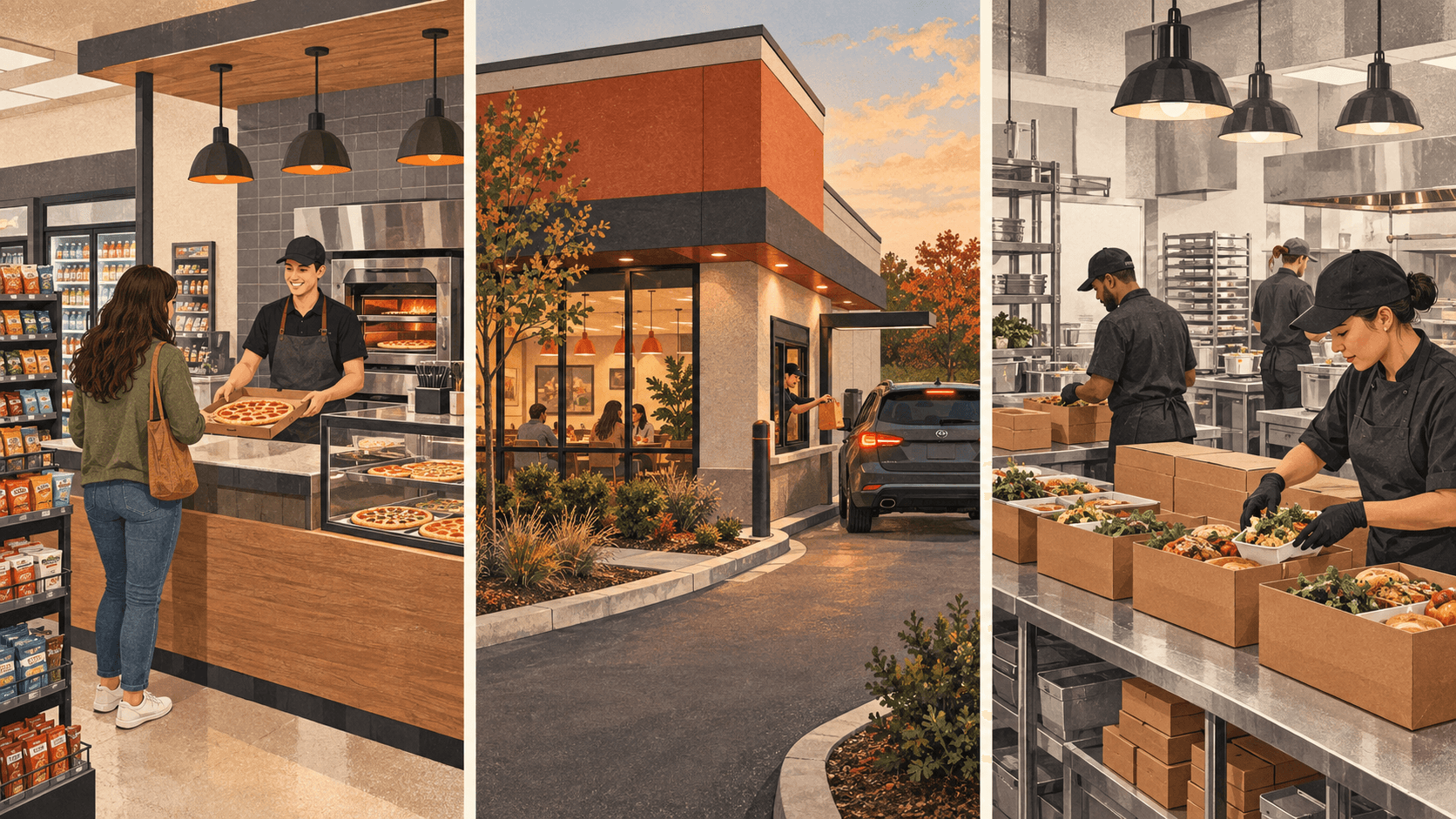
A Checkers & Rally's restaurant that could fit inside a two-car garage is not a gimmick. At 570 square feet, the chain's new prototype is roughly half the size of its traditional units, and it represents something far more significant than a space-saving trick. It is a survival calculation, worked out in concrete and rebar, that a growing number of QSR operators are arriving at independently.
Across the industry, chains are methodically stripping the dining room, shrinking the kitchen footprint, eliminating seating requirements, and redesigning the entire customer experience around a single channel: the drive-thru window, or increasingly, no window at all. The result is a generation of restaurants that are smaller, cheaper to build, cheaper to staff, and in many markets, more profitable than the full-size predecessors they are quietly replacing.
This is not a fringe movement. It is the structural response to a set of cost pressures that have made the traditional restaurant format unworkable at the unit economics that franchise investors require.
The Numbers That Forced the Change#
The pressures driving format miniaturization are not abstract. They show up in the P&L every month.
Construction costs for new restaurant builds have risen sharply since 2020. The National Restaurant Association's 2025 State of the Industry report documented that construction and equipment costs for a typical QSR unit had increased more than 35 percent over the prior five-year period, compressing the return on new capital investment. A unit that penciled at a 20 percent cash-on-cash return in 2019 often requires significantly higher sales volumes to hit the same threshold today.
Commercial real estate follows a similar trajectory. Ground-up builds in suburban growth markets now frequently require land purchases at prices that were unthinkable a decade ago. The shift to smaller formats is, in part, a real estate arbitrage: Taco John's "Drive Thru Olé" concept requires only 0.35 to 0.50 acres per site, less than half the land footprint of a traditional Taco John's unit. When land in a desirable suburban corridor runs $15 to $25 per square foot, cutting the land requirement by 60 percent changes the entire development pro forma.
Labor is the third leg of this equation. Black Box Intelligence data from late 2025 found that 9 percent of full-service restaurants and 4 percent of limited-service restaurants were at risk of closure, with labor costs as the primary driver in most cases. A traditional QSR dining room requires front-of-house staff for lobby cleaning, order taking, table maintenance, and restroom monitoring. A drive-thru-only or mobile-first format eliminates that entire labor category.
Digital ordering has accelerated the logic. At chains that have invested heavily in app-based ordering, digital transactions now represent 30 to 40 percent of total sales. When a customer has already placed, paid, and customized their order before arriving at the restaurant, the dining room serves no functional purpose in their experience.
What the New Formats Look Like#
The specifics vary by chain, but the design philosophy is consistent: remove everything that does not directly serve the transaction.
Checkers & Rally's new prototype stands at 570 square feet, down from the roughly 1,000 square feet of earlier builds. The reduction eliminates dining seating entirely while maintaining full kitchen capacity. The concept is designed for drive-thru and walk-up service, with no indoor guest area.
Taco John's "Drive Thru Olé" concept occupies 900 to 1,100 square feet on a site of 0.35 to 0.50 acres. The smaller land parcel opens site opportunities that would be unavailable to a standard build, including urban infill locations, underutilized corner parcels, and suburban pads adjacent to existing retail that lack sufficient acreage for a traditional QSR footprint.
Taco Bell's Go Mobile format is perhaps the most operationally sophisticated of the current-generation small formats. The concept reduces the building footprint by nearly half while adding dual drive-thru lanes and dedicated mobile order pickup shelves. The mobile shelves serve customers who placed orders through the app, allowing them to retrieve food without interacting with a cashier or merging into the traditional drive-thru queue. Dining space is minimal, reflecting the reality that Taco Bell's mobile ordering volume made the traditional dining room a cost center rather than a revenue driver.
McDonald's CosMc's concept is narrower in scope: a beverage-forward, drive-thru-focused format with a dramatically reduced footprint compared to a standard McDonald's. The concept does not attempt to replicate the full McDonald's menu. Instead, it targets the morning and afternoon occasion that Starbucks has historically owned, using a smaller building and simplified operations to compete on convenience and speed.
Dutch Bros: The Proof of Concept#
Before the major QSR chains began rolling out small-format pilots, Dutch Bros was quietly building a proof of concept for the drive-thru-only model at scale.
Dutch Bros operates no dining rooms. Its locations are purpose-built drive-thru structures, often occupying minimal footprints on sites that would be too small for a traditional chain unit. The model concentrates labor entirely on drink preparation and order delivery, with no front-of-house staff, no dining room maintenance, and no lobby to clean.
The results speak for themselves. Dutch Bros opened 175 new locations in 2026, making it one of the fastest-growing chains in the country by unit count. The company's same-store sales growth has consistently outpaced the broader beverage category. At a time when Starbucks is wrestling with traffic declines and operational complexity across its thousands of full-service cafes, Dutch Bros is expanding aggressively with a stripped-down model that requires less capital, less labor, and less real estate.
The Dutch Bros trajectory is instructive for operators considering small-format investments. The model works not because it cuts corners on product quality, but because it concentrates investment precisely where the customer interaction occurs and eliminates spending on everything else.
Automation Expands the Possibilities#
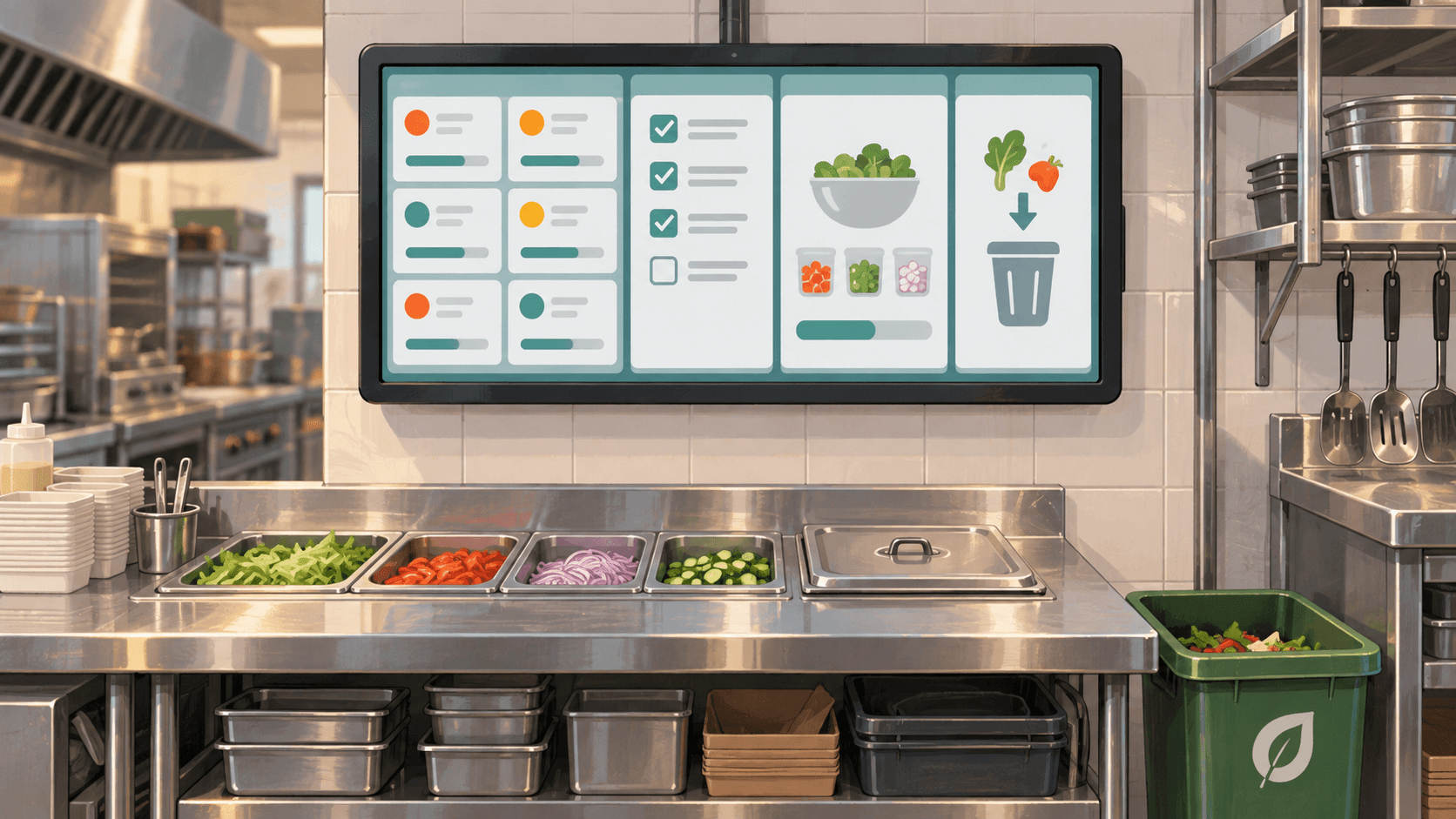
Sweetgreen's Infinite Kitchen format represents the most technologically intensive version of the small-footprint trend. The automated make-line, built around robotics developed in partnership with Hyphen, handles the physical assembly of salad orders without human involvement in the production process. Sweetgreen has framed the Infinite Kitchen as a throughput play, capable of producing significantly more meals per labor hour than a traditional line.
From a footprint standpoint, an automated kitchen line occupies predictable, fixed space. It does not require the adjacency of a dining room to justify its presence. The Infinite Kitchen format can theoretically be deployed in locations where a traditional Sweetgreen could not operate profitably, including high-density urban spaces where square footage costs are prohibitive for full-service formats.
Miso Robotics, which produces the Flippy automated cooking arm used in some QSR kitchens, was acquired by Zignyl in early 2026. The consolidation signals that kitchen automation is moving from pilot-phase curiosity to operational infrastructure, with technology providers seeking the scale and integration capabilities that will make their systems viable across multi-unit operator portfolios.
The intersection of format miniaturization and kitchen automation is worth watching. A smaller building with a higher degree of automated production requires fewer workers, occupies less space, and produces fewer points of failure. The economics compound.
Why the Traditional Format Is Under Pressure#
The conventional QSR format of the past 30 years, a 2,000 to 2,800 square foot building with a 50- to 75-seat dining room, a single drive-thru lane, and 15 to 25 employees per shift, was designed around a set of assumptions that no longer hold.
It assumed that a meaningful share of customers would eat inside the restaurant. Dine-in traffic at QSR has declined steadily for more than a decade, a trend that accelerated sharply during the pandemic and has not reversed. Dining rooms are now often occupied at 20 to 30 percent of their designed capacity during peak hours, representing a significant amount of built square footage that generates no incremental revenue.
It assumed that single drive-thru lanes could handle peak demand. As off-premises ordering and drive-thru adoption have grown, single-lane drive-thrus create backups that cost the chain transactions. The newer multi-lane configurations, including Taco Bell's dual-lane Go Mobile design and McDonald's restructured drive-thru layouts at thousands of locations, address throughput by adding physical capacity. That requires more real estate per lane, which pushes smaller footprint concepts toward drive-thru-free models rather than multi-lane configurations.
It assumed a labor model that staffed for lobby coverage. That assumption has been overtaken by both labor cost inflation and the operational reality of drive-thru-dominant sales mixes. A restaurant doing 80 percent of its volume through a single channel does not need to staff for the other 20 percent at the same ratio.
The Franchise Investment Implications#
For franchise investors evaluating new development opportunities, the shift toward smaller formats has direct implications for return calculations.
Lower land requirements reduce the capital intensity of new builds. If a small-format concept requires 0.4 acres instead of 0.9 acres, the developer either spends less on land acquisition or gains access to a broader set of viable sites. Both outcomes improve the development pro forma.
Lower construction costs from reduced square footage and simpler finish requirements cut the total investment per unit. A drive-thru-only concept with no dining room eliminates seating, flooring upgrades, restroom buildout to full-service standards, and the additional HVAC required to heat and cool an occupied dining area. Shell finish costs for a building that will never have dining room guests are substantially lower.
Lower ongoing occupancy costs from smaller lease footprints reduce fixed cost exposure, which is particularly valuable in markets where sales volumes fluctuate. A $6,000 monthly occupancy cost on a 900-square-foot drive-thru-only unit is a different break-even calculation than a $14,000 monthly cost on a 2,400-square-foot full-service build.
The trade-off is flexibility. A drive-thru-only format is harder to adapt if consumer behavior shifts back toward dine-in, and some markets, particularly in dense urban areas without car access, cannot be served effectively by drive-thru-dependent concepts. Operators evaluating small-format development should map their target trade areas carefully before committing to a footprint that eliminates indoor dining.
The Pipeline Is Building#
The chains that have announced or deployed small-format concepts are not the only ones watching. Every major QSR brand's real estate and development team has run the numbers on footprint reduction, and most of them have projects in various stages of approval.
The question is no longer whether smaller formats make economic sense. The question is how quickly chains can redesign their systems, approve new prototypes, retrain operators, and scale development. Prototype approval cycles at major chains typically run 18 to 36 months from concept to multi-unit rollout. The concepts being piloted now will define the physical shape of QSR real estate for the next decade.
Jersey Mike's, now operating with Blackstone's backing after an $8 billion transaction, has flagged format flexibility as a development priority. Raising Cane's, which is targeting 1,000 total locations while maintaining a single-item menu, has built its expansion model around operational simplicity that pairs naturally with smaller footprints. Formats that concentrate on a narrow menu executed at high volume are natural candidates for size reduction: fewer menu items mean smaller kitchens, less equipment, and lower build costs.
What It Means for Operators#
The practical takeaway for operators considering new builds or refranchise agreements is straightforward: the era of the 2,500-square-foot QSR with 60 seats and a single drive-thru lane as the default format is ending. What replaces it will vary by brand and trade area, but the direction is clear.
Operators evaluating development agreements should ask their franchisor for data on small-format unit performance, specifically same-store sales comparisons between new small-format builds and traditional units in comparable trade areas. Average unit volume data alone is insufficient: the relevant metric is sales per square foot and return on invested capital. A small-format unit that produces 85 percent of the sales of a traditional build at 55 percent of the construction cost is a superior investment.
The operators who will benefit most from this format transition are those who approach new site selection with a clear-eyed view of their trade area's vehicle traffic patterns, digital ordering penetration, and labor market conditions. In markets where drive-thru throughput is the dominant constraint on sales volume, dual-lane and drive-thru-only formats will outperform dining room builds. In dense urban markets with low vehicle access, the logic runs differently, and format selection must reflect that reality.
What the shrinking restaurant signals most clearly is that the industry's default assumptions about physical space are being rebuilt from scratch. The chains that figure out the right format for their specific economics sooner will carry a structural cost advantage into the next cycle of unit development. The ones that keep building the same building they built in 2015 will be competing with a tied hand.
QSR Pro Staff
The QSR Pro editorial team covers the quick service restaurant industry with in-depth analysis, data-driven reporting, and operator-first perspective.
More from QSR