Noble Roman’s said November 12 that it had sold 59 new locations and opened 41 so far this year. Franchising revenue for the nine months ended September 30 reached $4.76 million, up from $4.37 million a year earlier. Company update
The company’s September 2026 presentation describes a model in which convenience-store owners operate the pizza program under a 10-year franchise agreement. Customers can buy ready-made food or have a pizza made to order. Company presentation, pages 9 and 17
For pizza preparation, operators start with a fully prepared crust delivered in shelf-stable condition, according to the company’s filing. Quarterly filing
What the package covers#
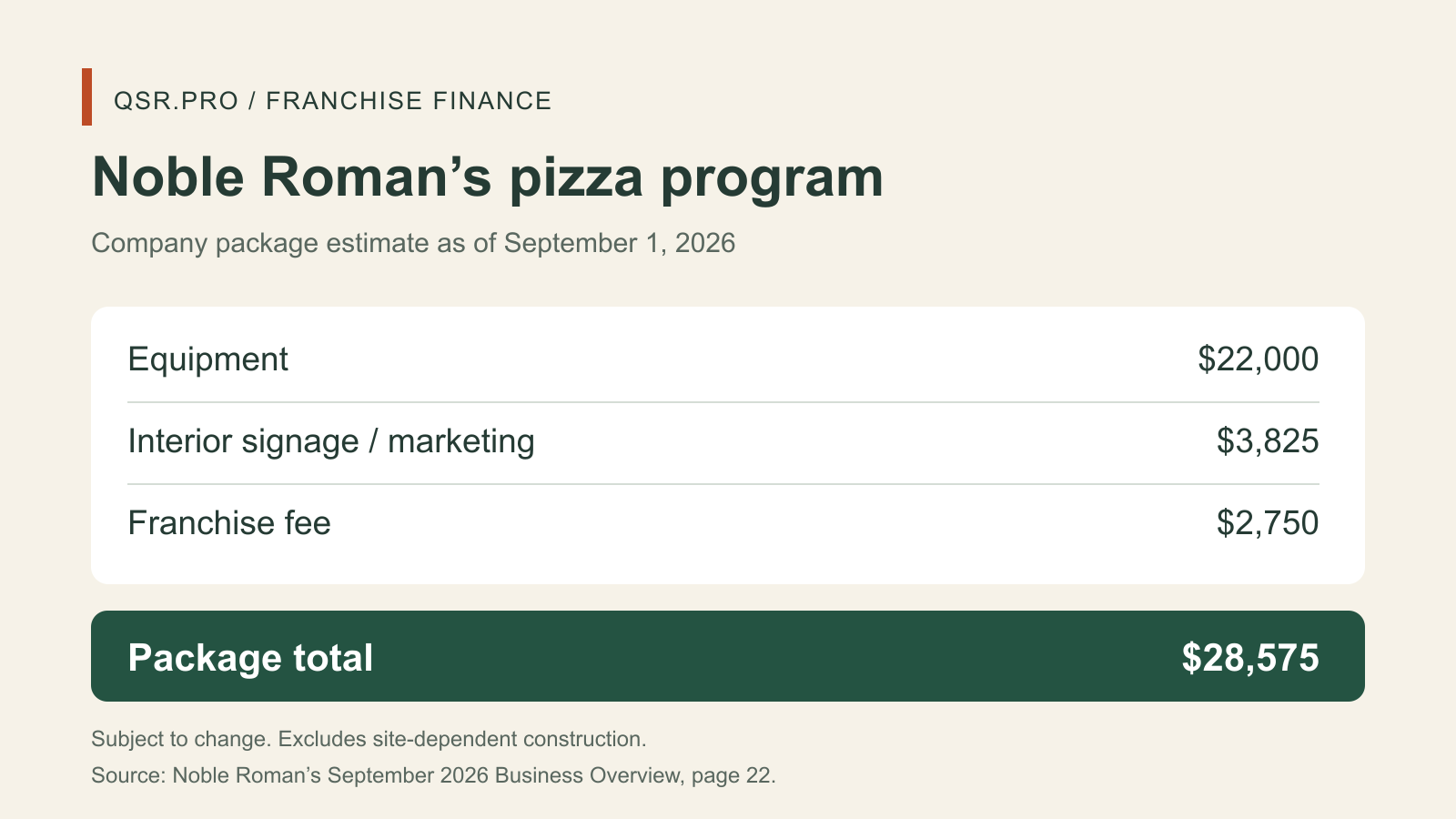
The presentation’s cost table, dated September 1, lists $22,000 for equipment, $3,825 for interior signage and marketing, and a $2,750 franchise fee. Together, those items total $28,575. The company says prices can change and excludes site-dependent construction. A store needing building work therefore faces an expense outside that package. September cost table
In the presentation’s installation examples, the company identifies stores in Jonesboro, Indiana, and Atmore, Alabama. Its photos show branded counters and food warmers inside existing retail space. Installation examples
Noble Roman’s describes the opening work in a program white paper revised in October 2026. A corporate coordinator works with the operator on facility preparation, equipment, smallwares, the initial food order and marketing materials. The company says it then sends a representative for five or six days to assist with opening. Program white paper
Sales stay on the store’s register#
The same document says the program uses the convenience store’s existing point-of-sale system. Operators report sales on Mondays, with royalties collected by bank debit that day. Noble Roman’s also says it samples and audits ingredient purchases through its suppliers to monitor inventory as a proxy for sales. Program white paper
The white paper describes the franchise agreement as typically lasting 10 years, with automatic renewal and restrictions on competition and rebranding. Program white paper
The latest quarterly filing confirms that royalty revenue is sales-based and generally collected weekly through the Automated Clearing House payment network. It also describes the supply arrangement: manufacturers produce proprietary ingredients to company specifications, while distributors maintain inventories and make weekly deliveries. Operators agree payment terms directly with those distributors. Quarterly filing
Equipment and food distribution also generate income for Noble Roman’s. The filing says equipment commissions compensate it for facilitating equipment sales; manufacturer and distributor allowances arise from franchisees’ purchases of ingredients. Those payments sit alongside franchise fees and royalties in the franchising revenue category. Quarterly filing
What the results measure#
The November 12 update reports nine-month franchising expenses of $1.28 million, down from $1.40 million. Subtracting the reported expenses from revenue gives $3.48 million, compared with $2.97 million a year earlier, an increase of about 17.5%. That is the company’s franchising contribution before its other costs, not a convenience-store operator’s profit. Company update
Noble Roman’s reports its own restaurants separately from franchising. Its segment contribution excludes corporate expenses, depreciation and amortization, interest and income taxes. These company accounts do not disclose a convenience-store franchisee’s profit after the cost of running the counter. Quarterly filing
QSR Pro Staff
The QSR Pro editorial team covers the quick service restaurant industry with in-depth analysis, data-driven reporting, and operator-first perspective.
More from QSR