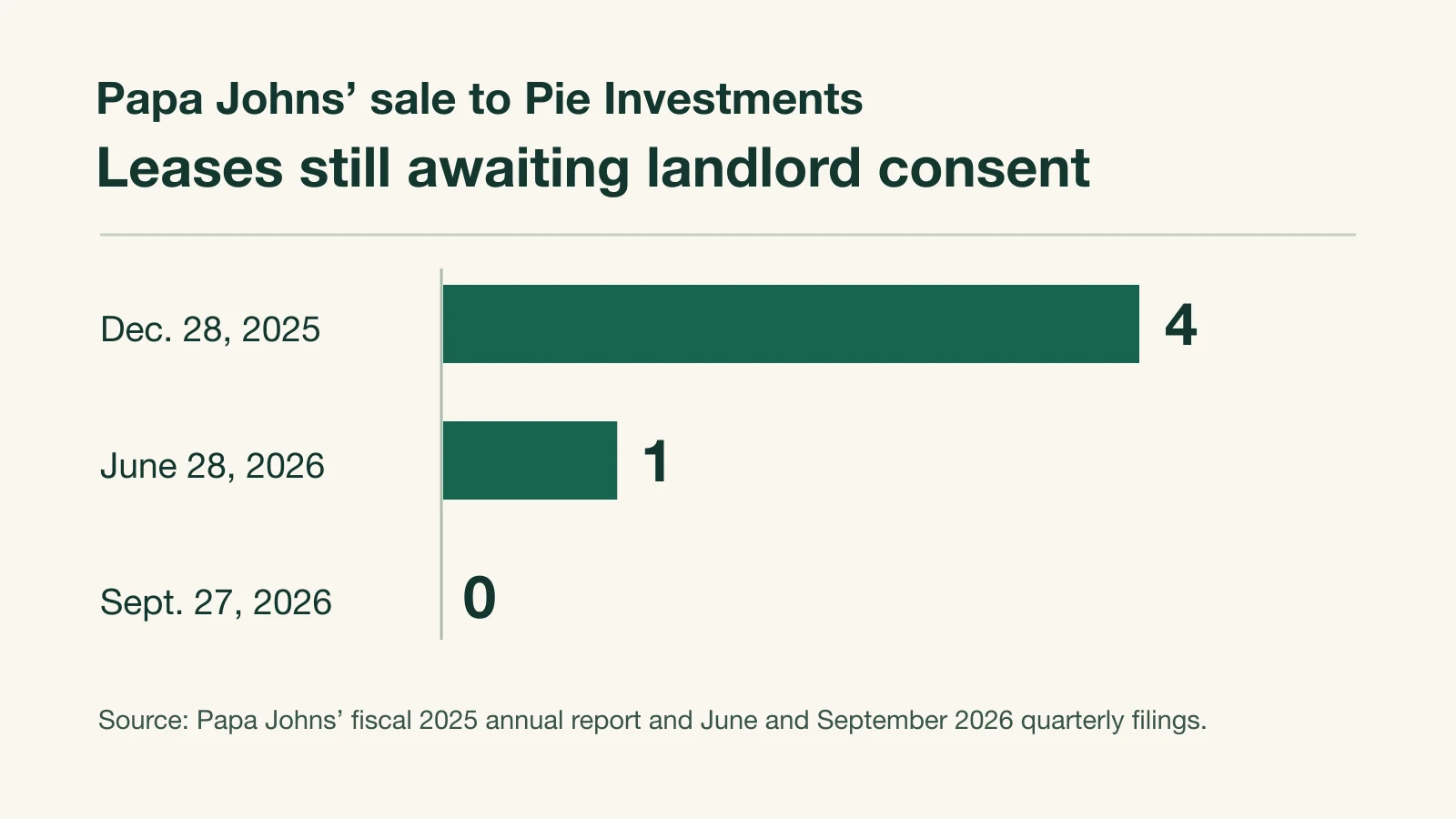
Landlords had approved all lease transfers in Papa Johns’ sale of 85 restaurants to Pie Investments by September 27, the company reported November 5.
The sale closed November 24, 2025. Pie, an existing Papa Johns franchisee, bought the domestic restaurants from Colonel’s Limited, LLC, the Papa Johns joint venture that owned and operated them. Colonel’s service agreement with Pie took effect that day.
Pie agreed to handle some of the management, supervision and administrative work at restaurants awaiting landlord consent. Each lease transfer needed the landlord’s approval under the purchase agreement. Papa Johns’ description of the agreement does not specify who covered rent or payroll.
What the seller still had to collect#
Four leases awaited approval on December 28, 2025. Papa Johns had collected $34.5 million of the $35.7 million price, leaving $1.2 million due upon assignment. About $2.4 million of the purchase price sat in escrow. The annual report classified those funds as restricted cash. The company could use the money for general purposes only after the parties completed the assignments and settled certain adjustments.
Papa Johns owned 70% of Colonel’s. Its annual filing classified the $34.5 million it received from the sale as an investing inflow. The $5.3 million distribution Papa Johns paid to the venture’s minority interest appeared under financing activities.
By March 29, 2026, landlords had approved three of the four transfers. Papa Johns booked a $1 million first-quarter gain on those transfers. It still expected $1.2 million in proceeds once the assignments and adjustments were complete.
How the sale changed first-quarter revenue#
Papa Johns began counting the 85 restaurants as franchises when the sale closed. In the first quarter of 2025, their sales had counted toward domestic company-restaurant revenue. In its first-quarter results, Papa Johns attributed about $25 million of the $31 million year-over-year decline in that revenue to the change in ownership.
Papa Johns also compared sales at the same group of domestic company restaurants in the first quarters of 2025 and 2026. It reported a 5.2% decline after adjusting the comparison for the shift in ownership. QSR.pro’s earlier coverage explains why a restaurant sale can reduce a franchisor’s reported revenue even if customers keep ordering as before.
The last lease#
One lease still awaited approval on June 28. Papa Johns expected another $400,000 after the assignment and closing adjustments. It carried $100,000 in assets held for sale for that restaurant.
Papa Johns’ first-half cash flow figures combined proceeds from the Pie deal and a building sale. Of the $4.3 million total, $3.5 million came from the building, leaving roughly $800,000 from the restaurant sale.
By September 27, Papa Johns had received a total of $1.2 million in 2026 from the assignments and closing adjustments. Its quarterly filing classified the money as investing cash flow and gave no separate amount for the final lease.
Company-wide lease guarantees#
As of September 27, Papa Johns guaranteed about 90 domestic leases from earlier sales to franchisees. It estimated maximum undiscounted payments of about $17 million if primary tenants missed payments. It considered payment too unlikely to record a liability. Papa Johns did not say whether any guarantees involved Pie.
QSR Pro Staff
The QSR Pro editorial team covers the quick service restaurant industry with in-depth analysis, data-driven reporting, and operator-first perspective.
More from QSR