Dine Brands Global’s board adopted a stockholder rights plan on October 28, the same day Bloomberg reported that Cobblers Cove Capital and Arkhouse Management had offered $39 a share in cash for the restaurant parent. Bloomberg attributed the proposal to unidentified people familiar with the matter.
Dine announced the plan October 29, saying media reports of significant open-market purchases of its stock and derivatives prompted the move. The company said it wanted to protect a control premium for shareholders and give directors time to make informed decisions.
The business attracting that reported interest spans Applebee’s, IHOP and Fuzzy’s Taco Shop. Those brands comprised nearly 3,500 restaurants as of June 28, according to Dine’s announcement.
Franchise relationships and company restaurants#
Applebee’s and IHOP are franchised by Dine subsidiaries and affiliates. Franchisees’ restaurant sales are not Dine’s revenue, although they affect its royalties. The parent separately reports franchise revenue, company-restaurant sales and rental revenue in its quarterly filing.
Dine has also been buying restaurants from franchisees. The filing records 12 Applebee’s acquired in February 2026 and 48 in June. Management says such acquisitions can help it invest in the system, improve operations and develop a model for franchisees.
The acquisition program helps explain the difference between Dine’s own revenue growth and the sales trends at its brands. In its August 5 results, Dine reported second-quarter 2026 revenue of $240.9 million, up from $230.8 million a year earlier. It attributed the increase primarily to higher company-restaurant sales, largely reflecting the number and timing of restaurants acquired from franchisees.
For the same quarter, ended June 28, domestic comparable sales fell 1.8% at Applebee’s and rose 1.5% at IHOP. Dine’s net income available to common stockholders was $4.2 million, compared with $13.2 million a year earlier, on a GAAP basis. These are the parent’s financial results, rather than a measure of franchisees’ profits. Its third-quarter release is scheduled for November 4.
Second-quarter general and administrative expenses rose to $55.6 million from $50.8 million. Dine cited employee costs for its company-owned and dual-brand initiatives, reorganization costs and acquisition-related transaction costs in explaining that increase.
Existing restaurants are adding a second brand#
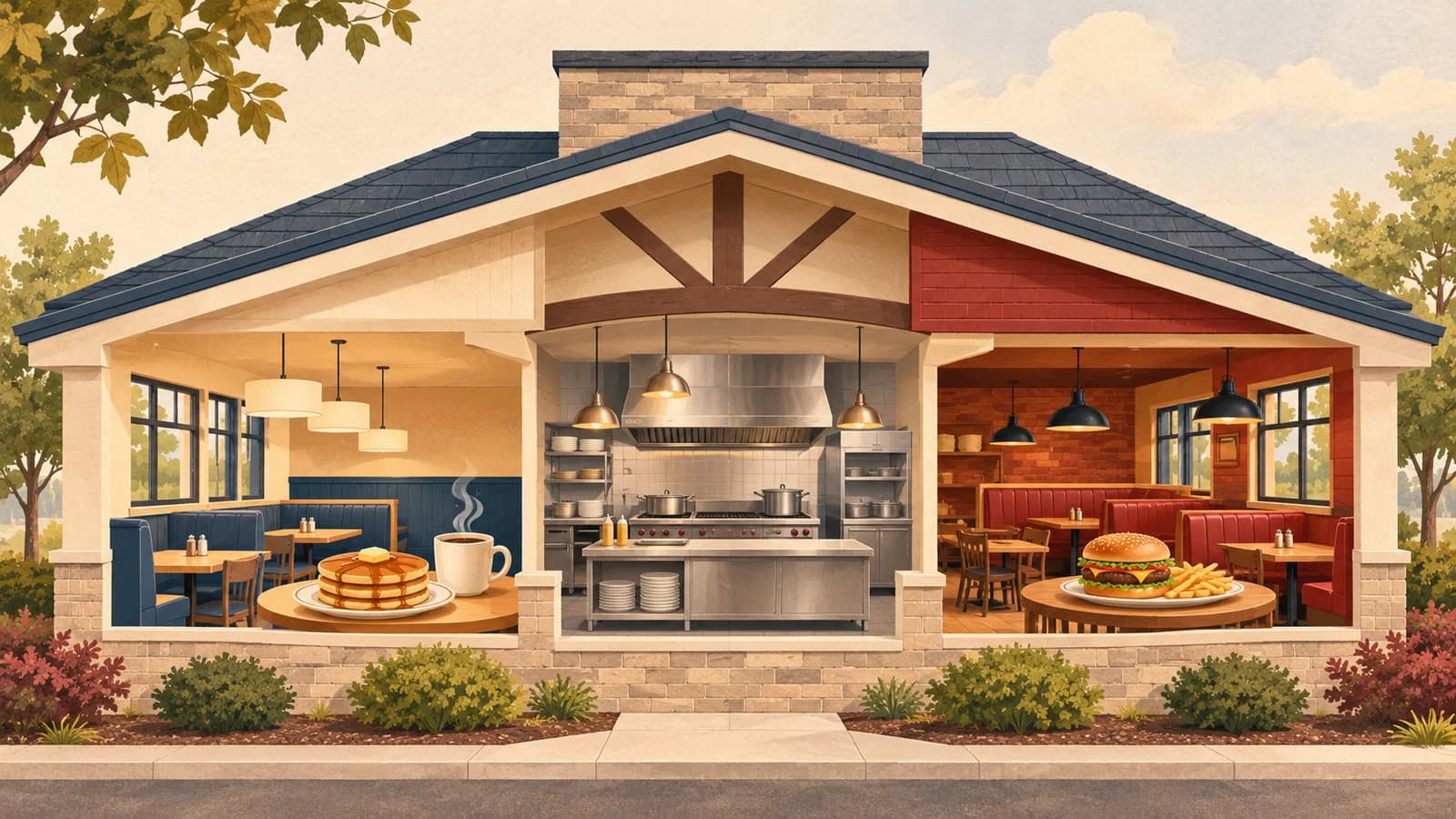
Dual-brand franchisees operate both concepts in one restaurant under separate franchise agreements. Dine counts each site in both brand totals. Dine’s second-quarter filing shows existing franchisees taking that path: three franchised Applebee’s added IHOP during the quarter, while two franchised IHOP restaurants added Applebee’s. A new franchised dual-brand restaurant also opened. The rollout includes conversions and new restaurant openings.
By September 15, Dine said its U.S. dual-brand network was approaching 50 locations. Its stated goal was approximately 80 domestic dual-brand restaurants by the end of 2026.
The company’s San Antonio opening announcement identifies The Hakim Group as both the location owner and an Applebee’s and IHOP franchisee. Dine described it as the eighth dual-brand restaurant in the greater San Antonio market. The format lets guests combine items from both brands on a single menu, from morning through late night. The San Antonio restaurant’s announced hours were 6 a.m. to 1 a.m. Dine describes distinct brand identities within the restaurant, connected by shared spaces, with dual-brand menu items including a Loaded Buffalo Chicken Omelette and an Ultimate Breakfast Burger.
How the rights plan affects control#
The rights agreement generally sets ownership thresholds of 10%, or 20% for qualifying passive investors. It also counts certain derivative exposure, based on the underlying shares held by counterparties. If an investor triggers its dilution provisions, that investor’s rights become void. Eligible other holders can buy common shares using a formula based on half the agreement’s defined market price, diluting the triggering investor’s ownership. That price generally averages the preceding 30 trading days.
Directors can redeem the rights before anyone becomes an Acquiring Person under the agreement. A merger or acquisition agreement approved by the board before that point also ends the rights when the transaction closes. The plan otherwise expires October 27, 2027. Those provisions preserve a route for a board-approved transaction alongside the conditional dilution mechanism.
QSR Pro Staff
The QSR Pro editorial team covers the quick service restaurant industry with in-depth analysis, data-driven reporting, and operator-first perspective.
More from QSR