QSR.pro
ArticlesChainsReportsToolsGlossaryMarket Map
Subscribe
QSR.pro

The definitive source for QSR industry intelligence. Deep research, real insight, and actionable analysis for operators, franchisees, and investors.

Never Miss an Update

Content

  • Articles
  • Reports
  • Glossary
  • Newsletter
  • Guides
  • Topics

Tools

  • Franchise Calculator
  • Wage Benchmarks
  • Market Map
  • Chain Database
  • All Tools

Company

  • About
  • Contact
  • Advertise
  • RSS Feed

Legal

  • Privacy Policy
  • Terms of Service

Connect

LinkedIn

© 2026 QSR Pro. All rights reserved.

Built with precision for the QSR industry

Share
  1. Home
  2. Industry Analysis
  3. The QSR Value Wars: How $5 Meal Deals Reshaped Fast Food Economics
Industry Analysis•Updated March 2026•6 min read

The QSR Value Wars: How $5 Meal Deals Reshaped Fast Food Economics

Q

QSR Pro Staff

The QSR Pro editorial team covers the quick service restaurant industry with in-depth analysis, data-driven reporting, and operator-first perspective.

Share:
Share:

Table of Contents

  • The $5 Meal Deal That Changed Everything
  • Why Value Became the Only Conversation
  • The Franchisee Squeeze
  • How McDonald's Evolved the Playbook
  • The Competitive Ripple Effect
  • What the Data Shows
  • The 2026 Outlook

Key Takeaways

  • In May 2024, McDonald's did something it had resisted for years.
  • The roots of the value wars trace back to 2022 and 2023, when fast food prices surged alongside broader inflation.
  • What made the value wars particularly painful for the industry was the tension between corporate strategy and franchisee economics.
  • McDonald's response to the franchisee pressure was instructive.
  • Every major QSR chain was forced to respond.

The $5 Meal Deal That Changed Everything

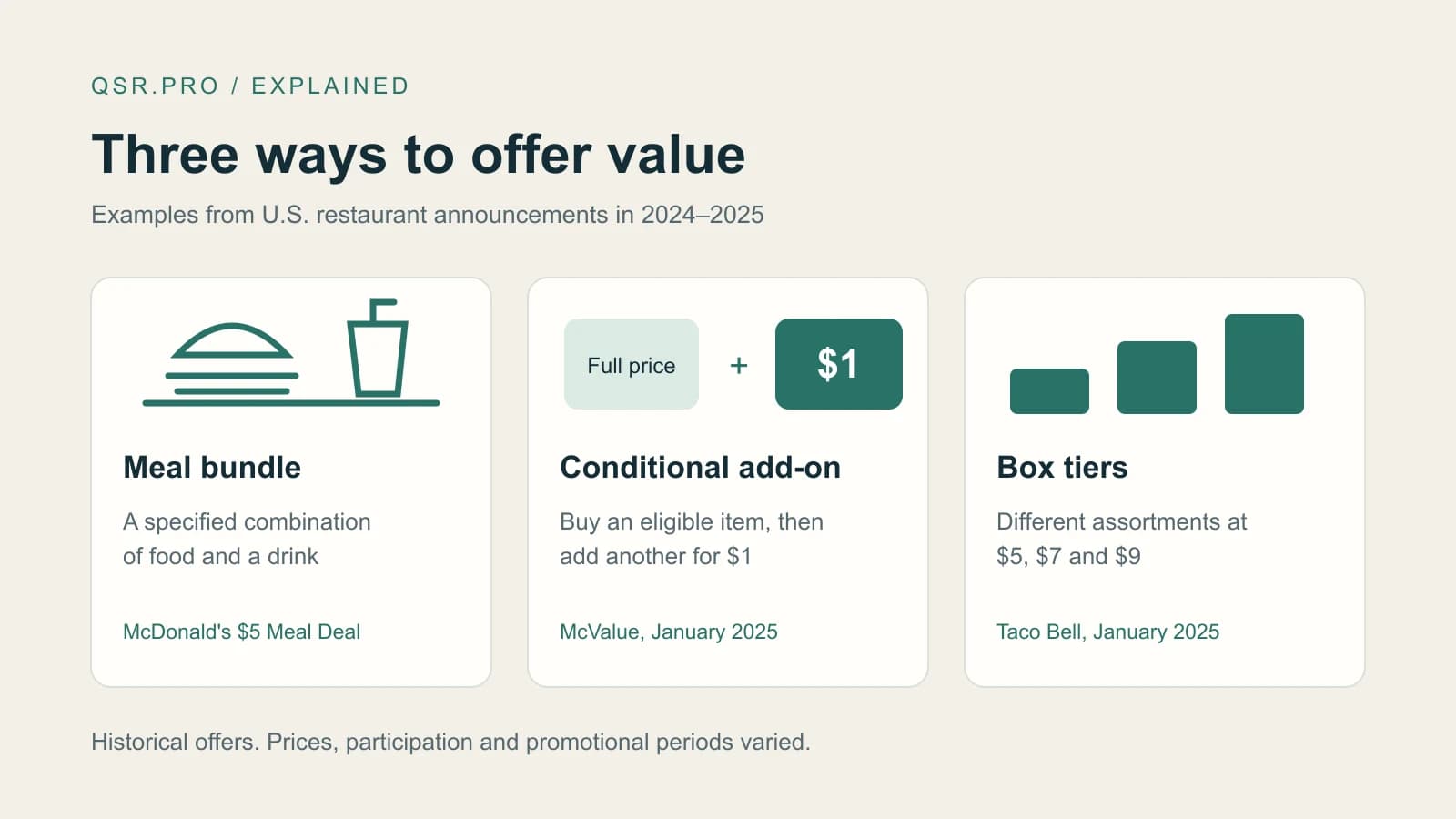
In May 2024, McDonald's did something it had resisted for years. The company launched a national $5 Meal Deal, a bundle that included a McChicken or McDouble, small fries, four-piece chicken nuggets, and a small drink. The offer was supposed to run for a month. It never really ended.

By the time McDonald's reported Q4 2025 results, the company revealed that same-store sales in the U.S. had jumped 2.4% year over year, the biggest increase in roughly two years. The McValue platform, which evolved from that initial $5 deal into tiered offerings at $5, $6, and $7 price points, was the primary driver. CEO Chris Kempczinski told analysts on the February 2026 earnings call that the value platform had been "the most effective traffic-driving tool we've deployed in years."

But McDonald's was not alone. By June 2024, Burger King had answered with its own $5 Your Way Meal. Wendy's rolled out a $3 breakfast deal and expanded its Biggie Bag lineup. Taco Bell doubled down on its Cravings Value Menu, adding new items at the $2 and $3 price points. The industry had entered a full-blown value war, and no major chain could afford to sit on the sidelines.

Why Value Became the Only Conversation

The roots of the value wars trace back to 2022 and 2023, when fast food prices surged alongside broader inflation. According to the Bureau of Labor Statistics, the food-away-from-home index rose 7.7% in 2023 alone. For an industry built on accessibility and affordability, that kind of price acceleration was existential.

Consumer sentiment shifted quickly. Surveys from the National Restaurant Association showed that by mid-2024, nearly 80% of consumers reported feeling that restaurant meals were "not a good value for their money." Traffic at QSR chains, which had been a relative bright spot during the pandemic recovery, turned negative. Year-over-year visit counts at the top 50 QSR chains fell for three consecutive quarters through Q2 2024.

The problem was structural. Franchise operators, squeezed by rising labor costs (particularly in states like California, where the fast food minimum wage hit $20 per hour in April 2024), rising food input costs, and persistent supply chain inflation, had passed those costs directly to consumers through menu price increases. A Big Mac meal that cost $8 in many markets in 2019 was suddenly $12 or more. A Chipotle burrito bowl that used to be $7.50 was $10.50. Consumers noticed. And they started staying home.

Also Read

McDonald's vs Jollibee: The Global Fast Food War Nobody Saw Coming

Jollibee operates 1,700+ stores across 18 countries, growing 8-10% annually while McDonald's grows at 2-3%. In the Philippines, Jollibee owns 50% of the QSR market while McDonald's sits at 15%. The fast food map is being redrawn.

Industry Analysis

The Franchisee Squeeze

What made the value wars particularly painful for the industry was the tension between corporate strategy and franchisee economics. When McDonald's headquarters mandates a $5 Meal Deal, corporate absorbs none of the margin compression. The franchisee does.

Consider the math. A $5 Meal Deal that includes four items has a food cost somewhere between $2.00 and $2.50, depending on the market and current commodity prices. That leaves $2.50 to $3.00 in gross margin before labor, rent, utilities, royalties (typically 4-5% of gross sales for McDonald's franchisees), and advertising contributions (another 4-5%). On a $5 transaction, franchisee-level profit is often measured in pennies, not dollars.

Multiply that across hundreds of transactions per day in stores where 30-40% of orders involve value menu items, and you begin to understand why the National Owners Association, an independent advocacy group representing McDonald's franchisees, pushed back aggressively against extending the $5 deal through 2025. The operators were not arguing against value. They were arguing against losing money on every third customer who walked through the door.

The same dynamic played out at Burger King, where franchisees represented by the National Franchisee Association publicly expressed concern about the sustainability of deep discounting. At Wendy's, the tension contributed to the chain's broader strategic review, which culminated in the Project Fresh turnaround plan announced in late 2025.

How McDonald's Evolved the Playbook

McDonald's response to the franchisee pressure was instructive. Rather than abandoning the $5 deal, the company expanded it into a tiered value platform. The McValue menu launched in January 2025 with options at $5, $6, and $7, giving customers a broader range of entry points while offering franchisees slightly better margins on the higher-priced bundles.

The $6 option added a larger entree or an extra side. The $7 tier included premium sandwiches. The strategy was designed to anchor on the $5 price point for traffic while using the tiers to trade customers up. Early results suggested it was working. McDonald's reported that the average transaction value on McValue orders was $6.20, meaning most customers were choosing the $6 or $7 options rather than defaulting to the base $5 deal.

There was also a digital component. McDonald's tied exclusive value offers to its app, which had crossed 40 million active U.S. users by Q3 2025. App-only deals, like a free medium fry with any $1+ purchase or a $4 bundle available only through mobile ordering, served a dual purpose. They drove app adoption, which generates valuable first-party data. And they allowed McDonald's to offer aggressive value without displaying those prices on the menu board, where they would set price expectations for walk-in customers.

Recommended Reading

The Rise of Mediterranean QSR: The Fastest Growing Segment You're Not Watching

Industry Analysis

Why Korean Fried Chicken Is Taking Over American QSR

Industry Analysis

The Competitive Ripple Effect

Every major QSR chain was forced to respond. Burger King, which had been struggling with traffic declines for most of 2023 and 2024, leaned into value as a centerpiece of its "Reclaim the Flame" brand turnaround. The chain's $5 Your Way Meal became a permanent menu fixture by the end of 2024, and the company added limited-time bundle offers throughout 2025 to keep the value message fresh.

Taco Bell took a different approach. Rather than competing directly at $5, the chain leaned into what it called "affordable indulgence," a strategy built around offering highly customizable, craveable food at price points that felt like a deal without requiring explicit discount branding. The Cravings Value Menu, anchored at $2 and $3 items, gave Taco Bell a natural advantage: its food costs are among the lowest in QSR, thanks to a protein mix that skews heavily toward beans, cheese, and seasoned beef rather than premium chicken or fresh produce.

Taco Bell's parent company, Yum! Brands, reported in March 2025 that Taco Bell had crossed $1 billion in annual operating profit for the first time, a milestone that underscored the chain's ability to drive both traffic and profitability simultaneously. While competitors were sacrificing margin to buy traffic, Taco Bell was growing both.

Wendy's found itself in the most difficult position. The chain's premium positioning, built around "fresh, never frozen" beef and higher-quality ingredients, made it harder to compete on pure price. When Wendy's did offer value deals, like its $3 breakfast offer and Biggie Bag bundles, the margin impact was more severe than at McDonald's or Taco Bell because Wendy's food costs are structurally higher.

What the Data Shows

Revenue Management Solutions, a consultancy that tracks QSR pricing, reported in January 2026 that average fast food prices increased 2.8% year over year in Q4 2025. While that is a significant slowdown from the 7-8% increases seen in 2022 and 2023, it is still positive price growth, meaning menu prices are still going up, just more slowly.

The more telling metric is traffic. According to Placer.ai foot traffic data, QSR chains as a category saw flat to slightly negative year-over-year traffic through most of 2025. The chains that gained traffic were disproportionately those with the strongest value platforms: McDonald's, Taco Bell, and Chick-fil-A (which competes on speed and consistency rather than price but benefits from a perception of value relative to fast-casual alternatives).

The losers were chains caught in the middle, brands that could not match McDonald's scale on value and could not differentiate enough on quality or experience to justify higher prices. Wendy's, Burger King, Jack in the Box, and several regional burger chains all saw traffic declines through 2025.

The 2026 Outlook

The value wars show no sign of ending. McDonald's has committed to maintaining its McValue platform through 2026 and has hinted at further app-exclusive offers designed to deepen digital engagement. Burger King is investing in kitchen equipment upgrades to improve food quality while maintaining value pricing. Taco Bell is expanding its Cantina restaurant format, which offers an elevated experience at similar price points.

The fundamental challenge remains: consumers have been trained to expect $5 meals, and pulling those offers will trigger immediate traffic declines. But franchisees cannot sustain penny-level margins indefinitely. The resolution will likely come through a combination of digital-only value offers (which reduce visible discounting), menu engineering that nudges customers toward higher-margin items, and gradual price increases on the value tiers themselves.

For the QSR industry, the value wars of 2024-2026 represent a structural reset. The era of aggressive menu price increases is over. The era of fighting for every transaction at the lowest possible price point has begun. And the chains that survive will be the ones that figure out how to serve a $5 meal and still make money doing it.

Q

QSR Pro Staff

The QSR Pro editorial team covers the quick service restaurant industry with in-depth analysis, data-driven reporting, and operator-first perspective.

More from QSR

Frequently Asked Questions

Table of Contents

  • The $5 Meal Deal That Changed Everything
  • Why Value Became the Only Conversation
  • The Franchisee Squeeze
  • How McDonald's Evolved the Playbook
  • The Competitive Ripple Effect
  • What the Data Shows
  • The 2026 Outlook

Free Tools

  • Compare FranchisesSide-by-side analysis
  • Franchise ROI CalculatorModel investment returns
  • Franchises by StateBrowse by location
View all tools

Explore

  • Finance & Economics
  • Marketing & Growth
  • Operations & Management
  • People & Culture
  • Technology & Innovation
Previous

How Wawa Is Quietly Becoming a QSR Giant

Industry Analysis
Next

McDonald's Big Arch and the Premium Burger Arms Race

Industry Analysis

Get more insights like this

Subscribe to our daily briefing

More from Industry Analysis

View all
Industry Analysis•

McDonald's vs Jollibee: The Global Fast Food War Nobody Saw Coming

Jollibee operates 1,700+ stores across 18 countries, growing 8-10% annually while McDonald's grows at 2-3%. In the Philippines, Jollibee owns 50% of the QSR market while McDonald's sits at 15%. The fast food map is being redrawn.

QSR Pro Staff•5 min read
Industry Analysis•

The Rise of Mediterranean QSR: The Fastest Growing Segment You're Not Watching

Mediterranean QSR grew 14% in 2024 vs 4% for fast-casual overall. Cava crossed B in revenue with 350+ locations heading to 1,000 by 2032. Average unit volumes hit .5M-.8M with 24-27% margins. This category is exploding.

QSR Pro Staff•6 min read
Industry Analysis•

Why Korean Fried Chicken Is Taking Over American QSR

Korean fried chicken chains grew from 200 to 500+ U.S. locations in six years. Bonchon (120+ stores), bb.q Chicken (50+), and Pelicana (40+) are expanding aggressively. Double-frying, thin crispy skin, and gochujang glazes are winning customers from KFC and Popeyes.

QSR Pro Staff•7 min read
Industry Analysis•

Buc-ee's: How a Gas Station Became America's Most Beloved QSR Destination

Individual Buc-ee's locations generate M-M annually, 5-10x typical gas stations. The chain operates 50+ stores with 100-120 gas pumps each, legendary bathrooms, and brisket sandwiches that drive cult loyalty. This isn't a gas station. It's a phenomenon.

QSR Pro Staff•7 min read

Related Articles

Industry Analysis•

McDonald's vs Jollibee: The Global Fast Food War Nobody Saw Coming

Jollibee operates 1,700+ stores across 18 countries, growing 8-10% annually while McDonald's grows at 2-3%. In the Philippines, Jollibee owns 50% of the QSR market while McDonald's sits at 15%. The fast food map is being redrawn.

QSR Pro Staff•5 min read
Industry Analysis•

The Rise of Mediterranean QSR: The Fastest Growing Segment You're Not Watching

Mediterranean QSR grew 14% in 2024 vs 4% for fast-casual overall. Cava crossed B in revenue with 350+ locations heading to 1,000 by 2032. Average unit volumes hit .5M-.8M with 24-27% margins. This category is exploding.

QSR Pro Staff•6 min read
Industry Analysis•

Why Korean Fried Chicken Is Taking Over American QSR

Korean fried chicken chains grew from 200 to 500+ U.S. locations in six years. Bonchon (120+ stores), bb.q Chicken (50+), and Pelicana (40+) are expanding aggressively. Double-frying, thin crispy skin, and gochujang glazes are winning customers from KFC and Popeyes.

QSR Pro Staff•7 min read
Industry Analysis•

Buc-ee's: How a Gas Station Became America's Most Beloved QSR Destination

Individual Buc-ee's locations generate M-M annually, 5-10x typical gas stations. The chain operates 50+ stores with 100-120 gas pumps each, legendary bathrooms, and brisket sandwiches that drive cult loyalty. This isn't a gas station. It's a phenomenon.

QSR Pro Staff•7 min read