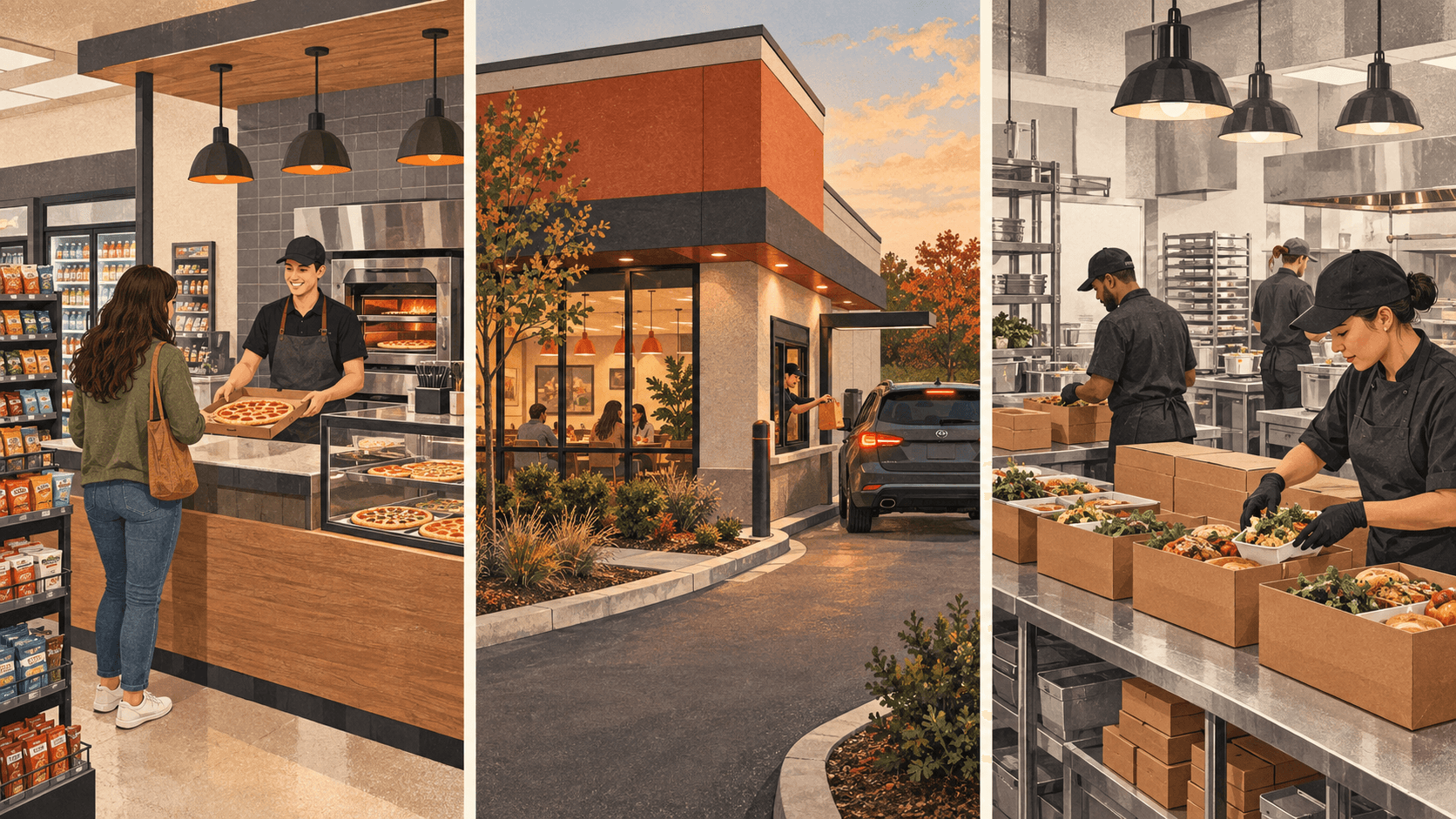
The average QSR operator spends more time engineering their menu than their packaging. That's a mistake that costs them twice: once at the register, and again in lost repeat customers.
Packaging for off-premise consumption adds 10-15% to the per-order cost structure - a line item that barely existed a decade ago. But unlike food costs or labor, packaging performance directly determines whether a customer who orders delivery once becomes a customer who orders weekly. The container holding a $12 burger matters as much as the burger itself.
This isn't about branding or sustainability messaging, though both matter. It's about the physics of keeping fried food crispy, preventing soup from leaking into a car seat, and ensuring a burrito bowl doesn't arrive as a burrito puddle. The gap between adequate packaging and excellent packaging is often fifteen cents. The gap in customer experience is everything.
The Hidden Economics of the Container#
Walk into any QSR finance meeting and packaging rarely gets strategic attention. It's treated as a commodity input, like napkins or straws. But the economics tell a different story.
Traditional dine-in packaging - paper wraps, cardboard clamshells, simple cups - costs roughly 3-5% of the average check. That's baseline. Off-premise adds structural requirements that drive costs up fast: leak-proof seals, thermal retention, stackability for delivery bags, tamper-evident features, and enough structural integrity to survive a 20-minute car ride.
The result: packaging costs for delivery orders run 10-15% of the ticket, sometimes higher for complex orders with multiple temperature zones. For a $40 family meal, that's $4-6 just in containers, bags, and utensils. At scale, across millions of orders, those pennies compound into strategic decisions.
But cost is only half the equation. A 2022 Technomic study found that 68% of consumers cite food quality upon arrival as the primary factor in whether they reorder from a restaurant. Packaging is the single largest determinant of that quality. A soggy sandwich isn't a kitchen problem - it's a packaging problem.
The operators who understand this don't treat packaging as procurement. They treat it as product development.
Engineering for the Three Absolutes#
QSR packaging engineers obsess over three non-negotiables: temperature, structure, and moisture management. Get any one wrong and the entire order fails.
Temperature: The 20-Minute Window#
Hot food must arrive hot. Cold food must arrive cold. The window is roughly 20 minutes from kitchen to door, though third-party delivery can stretch that to 40 minutes in dense urban markets.
McDonald's engineering team designed their clamshell boxes with a specific thermal profile: the molded pulp fiber retains heat while allowing just enough ventilation to prevent steam buildup that would make breading soggy. It's a deliberate tradeoff, calibrated for the average delivery time in their target markets.
For fried chicken, the challenge is inverse. Too much insulation traps moisture and ruins the crisp. Raising Cane's uses vented boxes with specific perforation patterns that allow steam to escape while maintaining enough heat retention to keep chicken above 140°F for transport. The vent placement is precise - too high and heat escapes too fast, too low and condensation pools at the bottom.
Pizza is the gold standard here. The corrugated box, often dismissed as low-tech, is actually a sophisticated thermal engineering solution. The fluting creates air pockets that insulate while the perforations regulate moisture. Domino's spent years testing hole patterns, box heights, and cardboard grades to optimize the temperature curve. Their current box design keeps pizza above 145°F for 30 minutes while preventing the dreaded soggy crust.
The newest challenge: mixed-temperature orders. A delivery bag with hot fries, a cold milkshake, and a room-temperature salad requires thermal zoning. Sweetgreen pioneered this with their insulated delivery bags that have separate hot and cold compartments, but the packaging itself must still perform. Their salad bowls are designed with enough thermal mass to stay cool even when packed adjacent to warm proteins.
Structure: Built to Survive the Last Mile#
A package that works in a controlled restaurant environment often fails in the chaos of delivery. The structural requirements are punishing.
Chipotle's burrito bowl is a case study in failure, then success. Early delivery packaging used standard paper bowls with plastic lids - cheap, simple, and a disaster in transit. Bowls collapsed under the weight of toppings, lids popped off in delivery bags, and guacamole ended up everywhere except the bowl.
Their engineering team redesigned from scratch. The current bowl uses a molded fiber base with a reinforced rim, specifically engineered to support stacking weight. The lid has a four-point snap closure with enough tension to survive being jostled but easy enough for customers to open without tools. The result: a 73% reduction in delivery complaints related to packaging failure, per Chipotle's own operations data.
Wing chains face a different structural problem: grease penetration. Traditional paperboard fails fast when saturated with oil. Wingstop's solution was a hybrid container: a wax-coated interior layer for grease resistance, a structural paperboard middle layer for strength, and a printed exterior layer for branding. The three-layer design costs 40% more than a simple box but reduces order remakes by 80%.
Shake Shack tackled the fragile order problem by rethinking containment entirely. Their burgers ship in a molded pulp tray nested inside a paper bag, with the tray designed to cradle the burger and prevent sliding. Fries get a separate vented container that clips into the same tray system. It's modular, stackable, and keeps components separated until the customer unpacks - a clean unboxing experience that customers notice.
The Sustainability Squeeze#
Environmental pressure is reshaping packaging economics faster than any other factor. Cities are banning polystyrene foam. States are mandating compostable materials. Customers are demanding plastic-free options. Every change costs money.
Compostable packaging runs 30-50% more expensive than conventional materials. A standard plastic soup container costs 8-12 cents. A compostable PLA alternative costs 12-18 cents. A molded fiber compostable option costs 15-22 cents. Multiply across thousands of daily orders and the math is brutal.
But the brands that moved early are finding competitive advantage, not just compliance. Sweetgreen committed to 100% compostable packaging in 2019, eating the cost premium to build brand differentiation with eco-conscious customers. By 2024, they reported that sustainability was a top-three purchase driver for 42% of their customer base - a market segment willing to pay higher menu prices specifically because of packaging choices.
The technical challenge is that sustainable materials often underperform on the engineering fundamentals. PLA (polylactic acid) compostable plastics don't handle heat well - put hot soup in a PLA container and it can warp. Molded fiber is great for structural integrity but terrible for liquids without a liner. Paper straws, the industry's most hated sustainability swap, collapse in cold drinks after 20 minutes.
The operators solving this are treating it as materials science, not marketing. Dig Inn worked with packaging supplier Zume (before its pivot away from packaging) to develop a molded fiber bowl with a bio-based moisture barrier that's both compostable and leak-proof. It costs 35% more than plastic but handles hot grains and cold proteins without failure.
McDonald's recently completed a multi-year engineering project to eliminate PFAS (per- and polyfluoroalkyl substances, aka "forever chemicals") from all packaging globally. PFAS had been used for grease resistance, particularly in fry cartons and burger wrappers. The replacement materials took three years to develop and cost an estimated 15-20% more, but the reputational risk of continuing PFAS use was incalculable.
Branding in the Unboxing Moment#
A delivery order is often the first physical touchpoint with a brand. The packaging is the handshake.
This is where the marginal cost of better packaging pays immediate dividends. A generic white container signals commodity. A custom-printed box with branded design signals care. The difference in unit cost is often less than ten cents, but the perceived value gap is much larger.
Chick-fil-A's packaging design is a masterclass in this. Every item - from sandwich boxes to sauce cups - features their logo, brand colors, and a clean design aesthetic that customers associate with quality. The packaging feels premium in a way that justifies their price positioning. When a Chick-fil-A bag arrives at your door, you know exactly what it is before you open it.
But branding only works if the engineering is sound. Beautiful packaging that fails functionally is worse than generic packaging that works. Cava learned this the hard way when they launched delivery with gorgeously designed bowls that leaked in transit. They pulled back, re-engineered the seal, and relaunched with packaging that was slightly less elegant but actually worked.
The smartest operators use packaging as silent customer service. Panera includes a card in delivery orders that explains how to reheat each item for optimal quality. It's printed on the bag, costs fractions of a cent, and prevents "this tastes bad" complaints that are actually "I microwaved this wrong" issues.
The Second-Order Effects: Packaging and Reviews#
Online reviews are where packaging decisions become revenue impact. Customers don't distinguish between food quality and packaging quality in their ratings. A melted milkshake is a one-star review, even if the kitchen made it perfectly.
A 2023 analysis of 50,000 delivery reviews across major platforms found that 34% of one-star reviews mentioned packaging failure: spills, leaks, cold food, or crushed items. These aren't kitchen failures - they're engineering failures.
The operators with the highest delivery ratings share a common trait: over-engineered packaging. They assume the worst-case scenario (dropped bag, 45-minute delivery, summer heat) and design for that. It costs more upfront but pays back in retention.
Dig Inn's packaging budget is reportedly 18% of delivery orders - well above industry average. But their delivery reorder rate is 47%, compared to a QSR industry average of 28%. The CFO's math is simple: spend an extra dollar on packaging, gain a customer worth $400 in lifetime value.
The Future: Smart Packaging and Material Science#
The next generation of QSR packaging is already in testing. Time-temperature indicators that show if food has been held too long. QR codes that link to reheating instructions or allergen information. Embedded RFID for tracking and theft prevention in delivery.
McDonald's is piloting reusable packaging in select European markets, using heat- and water-resistant RFID tags from Checkpoint Systems to track containers through return cycles. The economics are compelling at scale: a reusable container that lasts 100+ cycles costs $3 but replaces $0.25 disposable packaging each time. After 12 uses, it's net positive.
Material science is advancing too. Next-gen bio-based polymers promise the performance of plastic with the environmental profile of paper. Mycelium-based packaging - literally grown from fungi - is already used in protective shipping and may be viable for food service within two years.
But the fundamentals won't change. Hot food must arrive hot. Structure must survive transport. Sustainability must be balanced against performance. The operators who engineer for these absolutes, and treat packaging as a strategic investment rather than a commodity cost, will own the delivery era.
The fifteen-cent decision isn't about the container. It's about whether a customer becomes a one-time trial or a long-term habit. That's the real engineering problem worth solving.#
Related Reading#
- The Beverage Profit Machine: Why Drinks Drive QSR Economics
- The 4-Minute Wall: Why QSR Drive-Thru Speed Has Plateaued and What It Will Take to Break Through
- Inside the Fastest QSR Kitchens in America: What Raising Cane's, In-N-Out, and Wingstop Have in Common
- Wendy's 100% Sustainable Packaging Deadline: Inside the 2026 Race Against the Clock
QSR Pro Staff
The QSR Pro editorial team covers the quick service restaurant industry with in-depth analysis, data-driven reporting, and operator-first perspective.
More from QSR