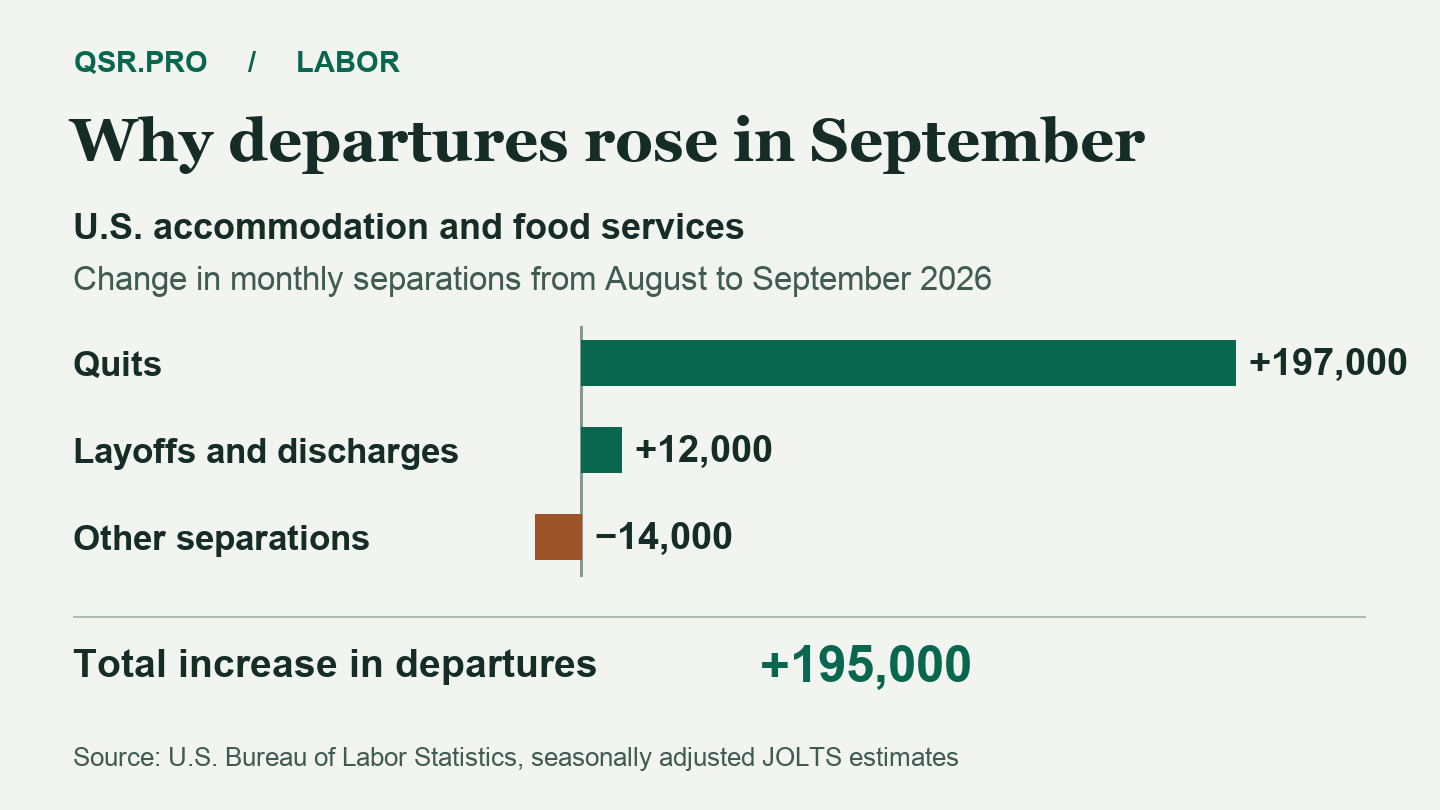
Workers quit an estimated 719,000 jobs in U.S. accommodation and food services in September, up 197,000 from a revised 522,000 in August. Total departures rose by slightly less, from 688,000 to 883,000, an increase of 195,000. The Bureau of Labor Statistics released the preliminary September figures on November 3. Job Openings and Labor Turnover Survey
The other two kinds of departures moved in opposite directions. BLS estimated 12,000 more layoffs and discharges and 14,000 fewer other separations. Other separations include retirements and transfers to another location of the same employer. Taken together, the two changes offset 2,000 of the increase in quits. The estimates are seasonally adjusted. BLS layoffs · Other separations · BLS definitions
The September 29 report put August quits at 507,000. Measured against that first estimate, September’s increase would be 212,000. BLS incorporates additional employer responses and recalculates seasonal factors when it revises the previous month. Its November report raised August’s estimate by 15,000, bringing the month-to-month increase to 197,000. First August estimate · Revised August estimate · BLS revision procedure
Two ways to measure quits#
The sector’s quit rate rose from 3.6% in August to 5.0% in September. BLS divides the month’s quits by the number of payroll employees who worked during the pay period covering the 12th or received pay for that period. A crew member who works two shifts a week counts as one employee, just as a full-time manager does. The national rate covers lodging and food services together. The release has no separate rate for quick-service restaurants. BLS quit rates · BLS employment definition
A manager looking at an exit log might ask what share of the departures were resignations. That calculation divides quits by all departures, including retirements and layoffs. In September, 719,000 quits out of 883,000 departures put the share at about 81%, up from 76% in August. Two stores with identical payroll counts and the same number of quits could have different shares if one laid off more employees. BLS departures · BLS quits
How the survey counts an open job#
The sector recorded an estimated 879,000 hires during September, up from 721,000 in August. Those monthly totals do not identify which hires replaced people who quit. Openings count vacancies on the last business day of the month. BLS estimated 659,000 openings at the end of September, down from 676,000 in August. BLS openings · BLS hires
Using that BLS series, the National Restaurant Association reported that openings averaged 670,000 from June through September, compared with 806,000 from January through May. Association analysis
A restaurant can have a closing supervisor’s job to fill without a vacancy that qualifies for the survey. If the owner intends to promote someone at that location and recruits only there, BLS excludes the position. To count as an opening, a job must have work available and a possible start within 30 days. The employer must also be actively recruiting outside the location. BLS openings definition
When a shift supervisor changes stores#
Consider two restaurants where the same company employs both crews. A closing supervisor transfers from the first restaurant to the second. Two crew members at the first restaurant resign. All three leave the first manager’s roster. Under the survey rules, the first store records two quits and one other separation. The receiving store records a hire, even though the supervisor has worked for the company all along. A promotion at the original store would produce no hire or separation. BLS classification of hires and separations
Suppose those were the month’s only departures and the first restaurant had 40 employees in the reference pay period. Two of its three departures were quits, and those two resignations give the store a 5% quit rate. Counting the transfer as a third quit would inflate that rate to 7.5%. The store’s raw 5% happens to match September’s seasonally adjusted estimate for the whole sector. BLS quit-rate table
If one of the crew members later returns to the restaurant, the original resignation still counts as a quit. The restaurant records a hire for the month the employee comes back. The owner can trace the supervisor’s transfer by matching the departure at one restaurant to the arrival at the other. The first manager still has closing shifts to cover, but the employer kept the supervisor. BLS payroll definitions
QSR Pro Staff
The QSR Pro editorial team covers the quick service restaurant industry with in-depth analysis, data-driven reporting, and operator-first perspective.
More from QSR