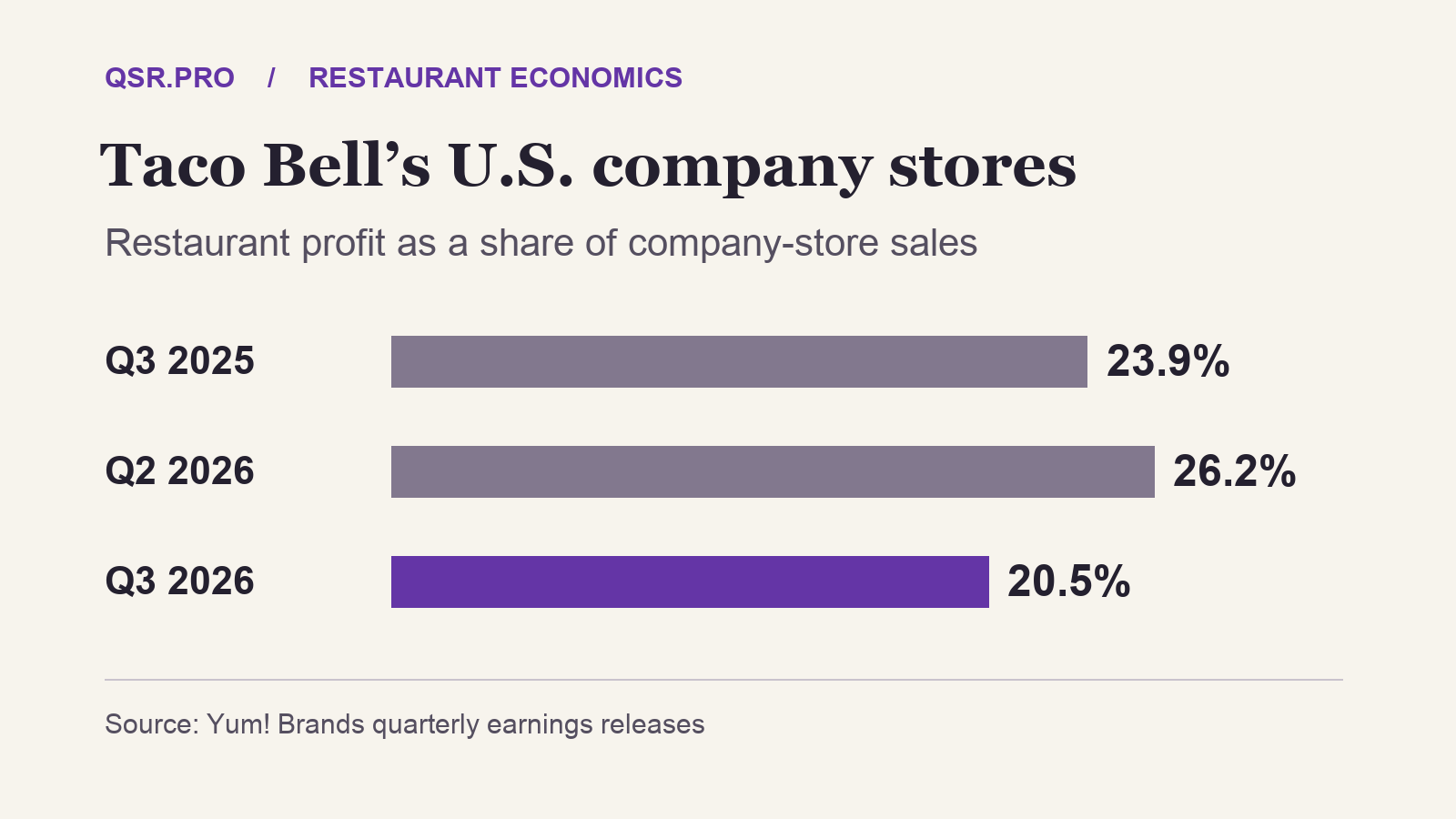
Taco Bell’s U.S. company-owned restaurants earned $20.50 in restaurant profit per $100 in sales in the quarter ended September 30, down from $23.90 a year earlier. The 20.5% margin Yum Brands reported November 3 fell within the 19% to 21% range it had forecast after Taco Bell withdrew affected lettuce in July.
Yum owned 8% of U.S. Taco Bells as of June 30. Across company and franchised stores, sales at comparable U.S. restaurants fell 4% from a year earlier. Total sales across the U.S. system fell 3%.
A franchisee can line up sales at the same restaurants over the same periods, then look at order counts and average checks. A higher average check can offset fewer orders.
Which restaurants count toward the margin#
The company-store margin fell 3.4 percentage points from the September 2025 quarter and 5.7 points from 26.2% in the June 2026 quarter. The year-over-year comparison spans a change in ownership. In late 2025, Yum bought 128 Taco Bells in the Southeast from a franchisee. Ahead of the purchase, Yum cited the established restaurants’ high margins as one attraction. Their sales already counted toward U.S. system sales. The purchase brought those restaurants’ sales and expenses into the company margin.
Yum calculates the margin by subtracting direct restaurant expenses from company-store sales and dividing the remaining profit by sales. It counts food, paper, store labor, rent and advertising, along with depreciation and amortization of restaurant assets. It excludes franchise operations and nonrestaurant general and administrative costs.
A franchise group using that figure as a reference can divide its combined restaurant profit by its combined sales. A restaurant with twice the sales of another carries twice the weight in that calculation. Simply averaging the two margins would give them equal weight. Using earnings before depreciation would also leave out a cost Yum counts. When sales fall, even an unchanged rent bill takes a larger share of each dollar. Yum’s November 3 release did not quantify the withdrawal’s effect on the margin.
What the sales figures say about the recovery#
U.S. same-store sales had risen 7% in the June 2026 quarter from a year earlier. The September decline followed a 7% increase in the September 2025 quarter, when Yum compared U.S. sales at comparable stores with the same period in 2024.
On July 17, Taco Bell said it had removed the affected Taylor Farms lettuce from its restaurants and its nationwide supply chain. In its filing for the June quarter, which discussed the July withdrawal, Yum said the episode had hurt U.S. sales and that sales had started to recover from their low point.
Taylor Farms de Mexico recalled the iceberg lettuce linked to the multistate Cyclospora outbreak. The lettuce reached retailers as well as restaurants. The CDC declared the outbreak over on September 11, and the FDA closed its investigation on October 2.
Yum CEO Chris Turner said Taco Bell’s U.S. same-store sales growth had outpaced the quick-service industry’s since September ended. The release gave neither rate. Both could have been negative.
QSR Pro Staff
The QSR Pro editorial team covers the quick service restaurant industry with in-depth analysis, data-driven reporting, and operator-first perspective.
More from QSR