Yum China says its upgraded AI assistant helps restaurant managers respond to changing traffic, while its service center assigns case managers to requests that cross back-office departments. The company described both tools in its November 12 announcement.
Its AI Store Assistant builds on Q-Smart, bringing restaurant operating data together with connected kitchen equipment to recommend production and staffing changes. Separately, the RGM One-Stop Service Center launched this year gives restaurant general managers an AI-assisted case manager for requests involving IT, human resources, supply chain, finance and other functions. The announcement gives no deployment count or measured savings for the upgrade.
From a screen to a conversation#
The original Q-Smart pilot, announced June 20, 2025, put a different interface around everyday management tasks. Managers could speak through wireless earphones or smartwatches rather than occupy their hands with a touchscreen or computer. The company described natural-language interaction for work ranging from labor scheduling to inventory and food-quality inspections.
For stock management, the company said the system compared inventory with upcoming sales forecasts and reminded managers when to order or replenish. Voice commands also supported equipment inspections and inventory counts. A company knowledge base supplied help with urgent operating problems. These are tasks a manager can handle during a shift.
That June announcement placed Q-Smart in selected KFC restaurants, with plans to use feedback before a larger rollout. It also documented the tools that came before it: AI-assisted scheduling and store management in 2019, the Super Brain decision-support tool in 2021, and handheld Pocket Managers in 2022. The pilot added hands-free interaction to tools managers had been using for years.
One place to follow a request#
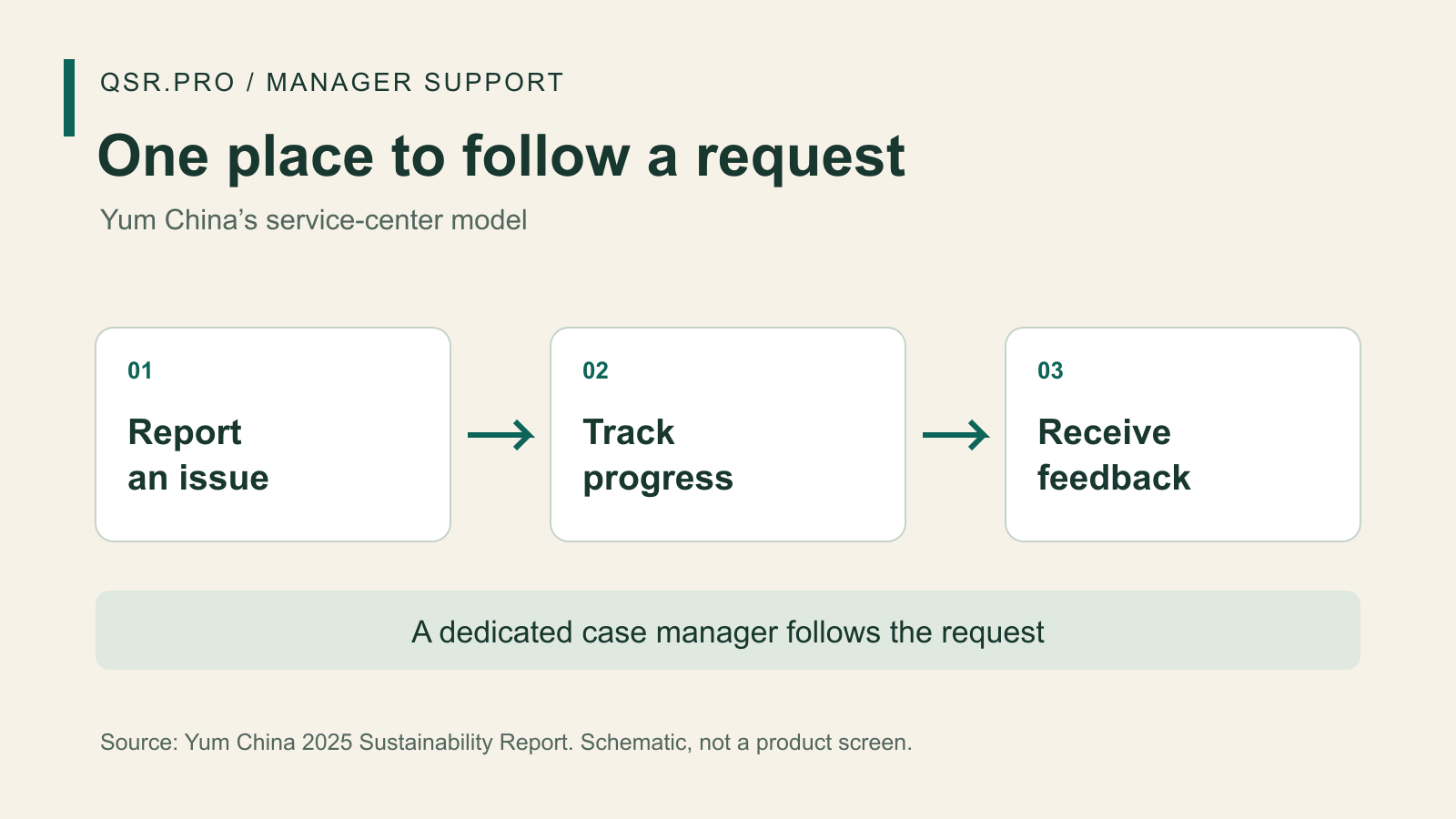
The service center also has a history before this week's announcement. Yum China's 2025 Sustainability Report, page 62 describes a pilot across more than 2,700 restaurants in four markets during that reporting period. Restaurants could report issues, track progress and receive feedback through one interface, while support teams saw real-time dashboards.
In the report's CEO remarks, Joey Wat described a dedicated case manager following each request from start to finish. She connected the redesign to feedback from restaurant managers about workflow bottlenecks. The stated aim was to give them more time for customers and team coaching.
The design combines a place to check a request with a case owner, replacing the need to navigate multiple support systems described in the report.
Supporting managers across stores#
Yum China has also been changing how it organizes restaurant management. In its 2025 annual filing, Yum China described Mega RGM, a shared-management model in which digital tools help capable managers oversee multiple restaurants. Transaction forecasts support staffing and inventory decisions; Super Brain combines store operating data to aid managers' judgment.
The filing also describes the people around that technology. A typical company-operated restaurant has a general manager and one or more assistants, with senior operations leaders monitoring and coaching managers. Restaurant management teams remain responsible for daily operations and compliance with operating standards. Centralized recruitment, training and support are intended to ease their workload. That is the management structure into which the new assistant and service-center tools fit.
QSR Pro Staff
The QSR Pro editorial team covers the quick service restaurant industry with in-depth analysis, data-driven reporting, and operator-first perspective.
More from QSR