Restaurant spending rises as Wendy’s and Starbucks shares rally
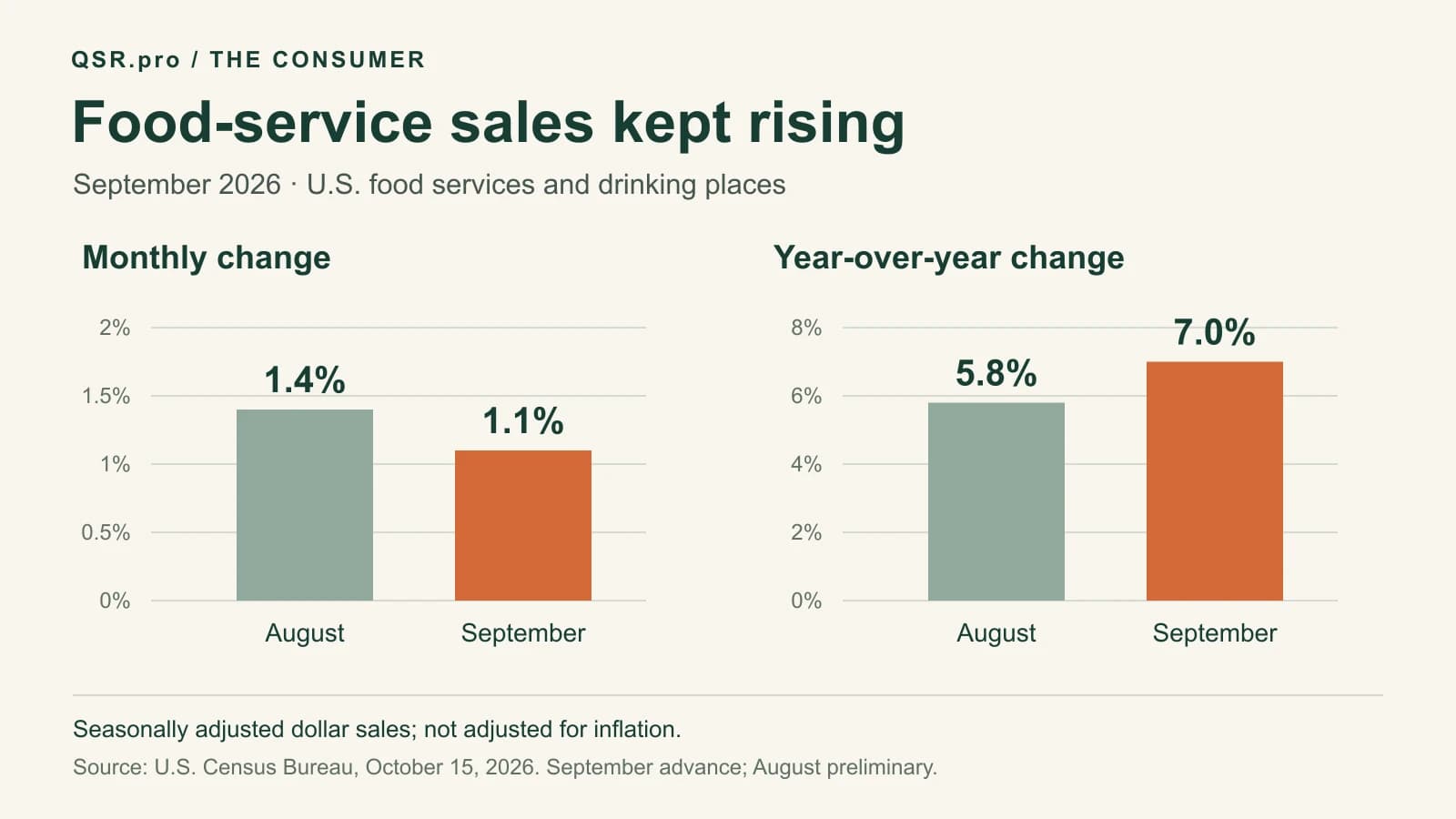
U.S. food-service sales reached $92.9 billion in September. Earlier results at McDonald’s and Wendy’s show how larger checks can support sales and cushion rising costs.
Showing 1–20 of 28 articles

U.S. food-service sales reached $92.9 billion in September. Earlier results at McDonald’s and Wendy’s show how larger checks can support sales and cushion rising costs.

New reports show rising grain prices and easing U.S. wholesale beef.
WOWorks ties franchise fee reductions, refunds and royalty relief to development commitments. Operators need to put the incentives on the same calendar as their openings.
Yum China's 300th Burger Bar extends an adjacent-store format. The operating question is how shared resources affect costs and contribution across both businesses.
Wingstop quantified how development offset weaker comparable sales in Q2. The calculation explains corporate growth without establishing franchisee profit.
Producer energy prices rose faster than food prices in May. Restaurant buyers need invoice weights and contract terms to estimate their own cost changes.
One qualifying adult entrée earns one free kids meal. Sunday, dine-in and counter-order requirements define the family occasion and its economics.
The first-quarter reconciliation shows how stronger restaurant contribution can coexist with a company operating loss, and which costs sit between them.
Systemwide same-shop transactions grew 5.1% in Q1, while company-shop gross margin fell to 20%. Coffee, food and rent weighed on costs.
Delivery supplied about 54% of company sales in Q1. Rider costs squeezed restaurant margin, while corporate cost savings helped operating margin rise.
The distributor’s margin, a store’s invoice and a franchisee’s profit-sharing credit measure different parts of the same supply relationship.
March’s CPI shows why slowing menu inflation does not automatically improve the comparison with groceries, and why the gap says little about restaurant profit.
A two-sandwich offer can drive app orders and account sign-ups. Its value depends on displaced purchases, order contribution and later visits.
Wingstop's digital sales mix hit 73.2% in Q4 2025, one of the highest penetration rates in QSR. The six-year arc from 39% to 73% has fundamentally altered the brand's labor model, throughput capacity, and expansion calculus. Here's what it means for the industry.
Commission rates are just the beginning. Data loss, operational friction, and brand damage push the true cost of aggregator delivery far higher than operators expect.
Double-digit premium increases, carrier withdrawals, and hidden coverage exclusions are squeezing QSR franchise economics
Taco Bell's Go Mobile is 1,325 square feet. McDonald's is testing carryout-only boxes. Chipotle's Chipotlane format eliminates dining rooms. The industry's biggest bet isn't on new menu items. It's on smaller buildings.
SBA loan defaults hit a 12-year high in 2024. The 7(a) program posted its first negative cash flow in 13 years. Restaurant lending standards are tightening. For overleveraged QSR franchisees, the math is getting ugly.
Net income down 44%, revenue declining, and a new interim CEO — Wendy's bets on technology and international growth to reverse course
Machine learning is transforming how restaurants predict traffic, schedule labor, and reduce waste — but adoption remains surprisingly uneven