Uber Technologies agreed October 6 to buy ezCater for $2.3 billion in cash. The companies expect closing in the coming months, subject to regulatory approvals and customary conditions. The proposed combination would connect ezCater's workplace-catering business with Uber Eats' reach and Uber for Business's corporate relationships. Transaction announcement
The companies said businesses can order from more than 140,000 restaurants nationwide through ezCater. The target reported more than $2.5 billion in gross bookings over the preceding 12 months, growing in the high teens year over year, and average orders above $400. Gross bookings measure order value, rather than platform revenue.
What a restaurant pays#
As of October 10, ezCater's published standard fees include a 15% commission on Marketplace orders and 7% on orders through its Online Ordering service for restaurant websites. Both carry a 2.99% payment-processing fee. Partners pay on accepted orders, with no signup or recurring monthly fee.
The percentages have different bases. Commission generally applies to the meal subtotal and the customer-facing delivery fee, excluding tax and voluntary tips. Processing applies to the subtotal, delivery fee and tax, excluding voluntary tips. Certain Dispatch delivery commissions use a flat charge, described below.
Optional marketing programs can add charges. For payouts, ezCater processes weekly deposits each Tuesday for the preceding Monday-through-Sunday billing period; it says the money typically arrives within one or two business days. Each location receives a separate payment by default, with combined deposits available by arrangement.
The restaurant's own website is a separate channel#
With Online Ordering, a visitor follows a catering link from the restaurant's website into an ezCater-powered checkout carrying the restaurant's branding. A chain can use a brand-level link or links for individual locations. The service supports catering menus, order minimums, lead times and future event dates.
Those orders enter the same Partner Portal as Marketplace orders. Restaurant staff use the same tools to accept and reconfirm them, assign drivers and track performance. ezCater says the lower commission reflects that the restaurant supplies the website traffic, while ezCater supplies the ordering technology, support and payment infrastructure.
The service also lets restaurants export their Online Ordering customers' contact information, company and industry, total order counts and communication opt-in status. Its pricing requirement is explicit: prices and fees must match the restaurant's lowest online pricing for comparable catering offerings.
Delivery has its own price and settings#
Dispatch connects restaurants to third-party catering drivers. Restaurants can request individual deliveries, choose automatic service or set rules for selected orders.
The standard charge is a $30 minimum for orders up to $300, then 10% of the entire order subtotal for orders over $300. Customers pay the restaurant a delivery fee. For on-demand and configured service, the restaurant covers any difference between that fee and the Dispatch charge. Automatic service sets the customer fee to match the Dispatch charge.
Delivery commission is separate. In-house and on-demand deliveries use the normal percentage on the customer delivery fee. Automatic and configured Dispatch instead charge $3 for orders below $500 and $5 for orders of $500 or more for that delivery-commission component. The flat charge does not replace the food commission or Dispatch delivery cost.
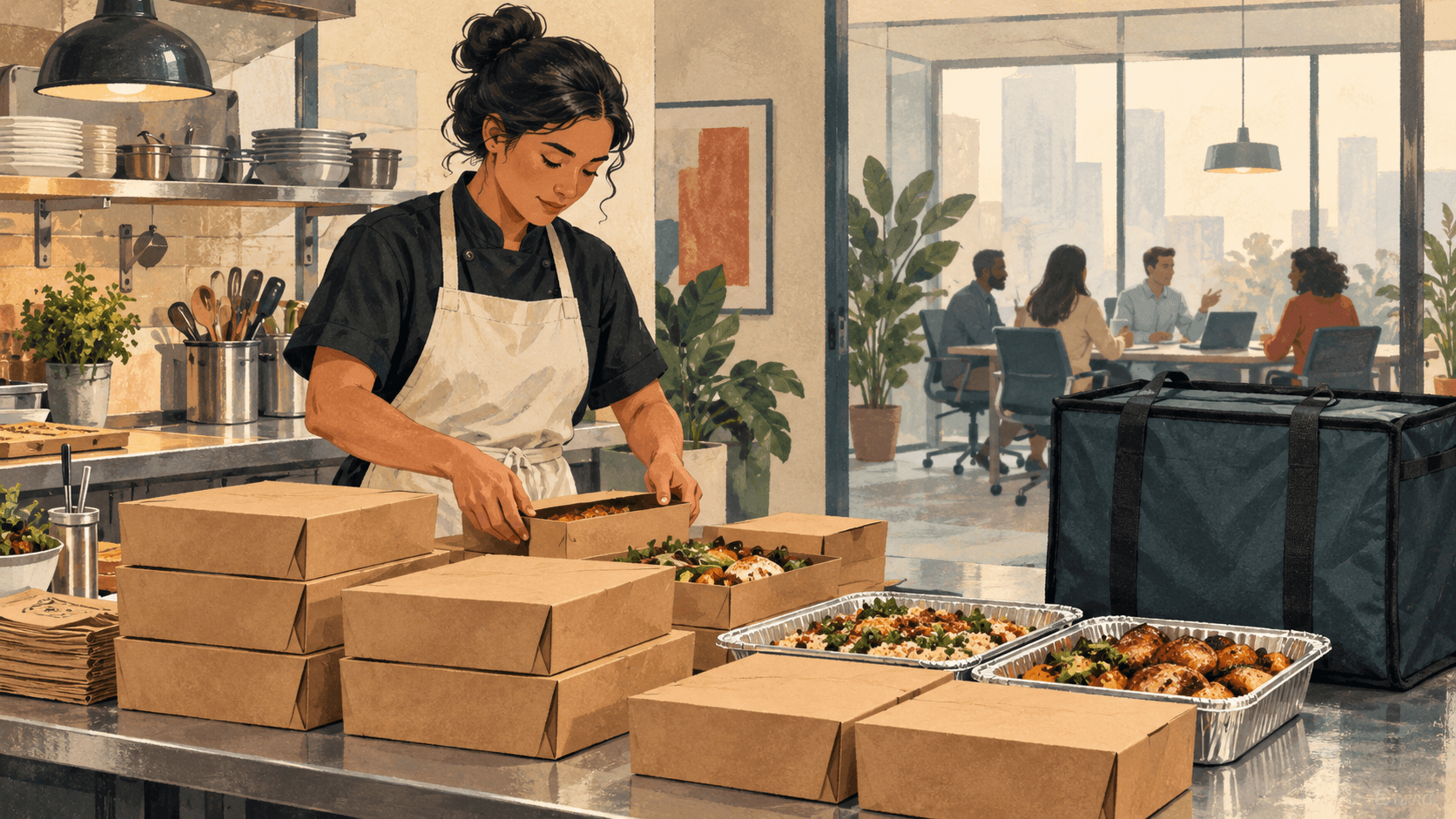
Restaurants still pack orders for scheduled pickup. Drivers are expected to provide basic setup when the order calls for it.
An advance order still needs an answer#
The platform's order-management instructions set acceptance windows based on notice: four hours for orders placed more than 24 hours ahead, and 30 minutes for those placed less than 24 hours ahead. New-order alerts are intended to support acceptance during operating hours.
Advance orders prompt a second confirmation the day before the event. Changes and cancellations create further tasks, so the store's commitment is revisited as the order develops. Modification messages link staff to the updated order for review; cancellation alerts identify an order that is no longer active. Delivery reminders can flag orders that still need a driver assigned or a Dispatch request.
Completed orders move into the restaurant’s history and reporting.
A group menu can take a different form#
Five Guys' January 13 rollout illustrates the menu work behind this channel. ezCater said approximately 800 U.S. Five Guys locations were joining its platform and that it had helped adapt the chain's menu for workplace buyers. Five Guys announcement
The offer ranged from small-group bundles to larger build-your-own bars where employees could assemble their meals, with burgers, hot dogs, sandwiches and fresh-cut fries.
QSR Pro Staff
The QSR Pro editorial team covers the quick service restaurant industry with in-depth analysis, data-driven reporting, and operator-first perspective.
More from QSR