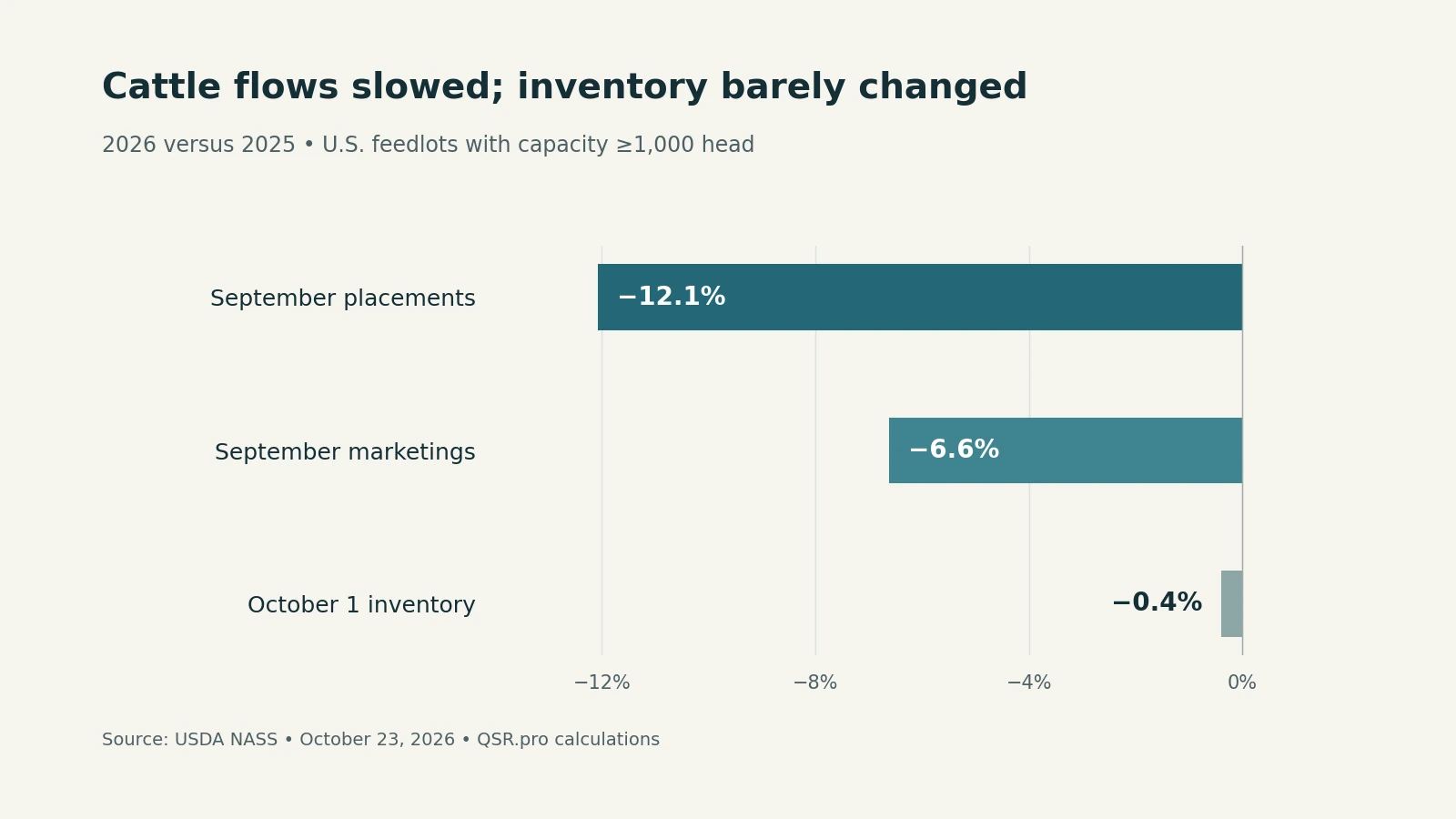
At U.S. feedlots with capacity of at least 1,000 head, September placements and marketings were the lowest for any September since USDA’s series began in 1996. Yet October 1 inventory was only 0.4% below a year earlier, at 11.372 million head, the October 23 report shows.
Feedlots began September with 88,000 more cattle than a year earlier. Compared with September 2025, 244,000 fewer entered, 108,000 fewer were marketed for slaughter and 2,000 fewer left through other disappearance, including deaths and transfers. Together, these changes explain the 46,000-head annual decline. Separately, inventory rose 204,000 head within September 2026.
The price comparison depends on the clock#
The wholesale beef price index rose 2.6% in September from August but was 3.6% below September 2025, according to USDA’s October 23 price table. The index measures prices received by domestic producers. QSR.pro reproduced both changes from BLS monthly values; June–September 2026 observations are preliminary.
Both comparisons can hold because they start from different months. September 2025 was a high comparison point: the BLS index had risen 9.7% that month from August. Neither monthly nor annual change alone describes the whole year.
USDA’s forecast for the 2026 annual-average wholesale-beef index is an 8.8% increase over the 2025 average, with a forecast interval of 4.8%–13.5%. That comparison includes months already elapsed. It does not predict another 8.8% increase from September’s level or a restaurant’s latest quote. Identifying the starting period changes what the number means for a purchasing discussion.
Different beef products carry different signals#
USDA’s October 16 livestock outlook adds a product distinction. It describes support for rib and loin prices ahead of the holidays alongside lower year-over-year boxed-beef values. Elsewhere in the report, it describes falling cull-cow prices and a steep decline in prices for 90%-lean beef trimmings.
Describing those declines, USDA writes: “The drop appears tied to increased availability of lower priced imported lean trimmings.” This is the agency’s qualified interpretation; this reporting has not independently established the cause.
Demand for ribs and loins need not describe the market for lean trimmings. A composite can capture several products without matching the one a restaurant purchases. The report does not measure whether these price changes reach restaurant purchase prices.
The outlook predates the October 23 cattle release.
Frozen stocks answer another question#
The October 23 Cold Storage report estimates 400.006 million pounds of frozen beef in covered warehouses on September 30, about 1% below both August 31 and the year-earlier level. Within that total, boneless beef fell 1.5% from August while beef cuts rose about 2%.
This is meat held in qualifying storage facilities. The measure includes imported and domestic products without distinguishing their origin. Its coverage excludes distributor and chain-store storage space, among other facilities, so it cannot be read as a count of beef held throughout restaurant supply chains.
Nor is frozen warehouse inventory a measure of fresh-beef availability. For operators assessing a supply claim, the useful detail is what stock the number covers. The national total cannot establish whether an individual supplier has more or less of a buyer’s required product.
QSR Pro Staff
The QSR Pro editorial team covers the quick service restaurant industry with in-depth analysis, data-driven reporting, and operator-first perspective.
More from QSR