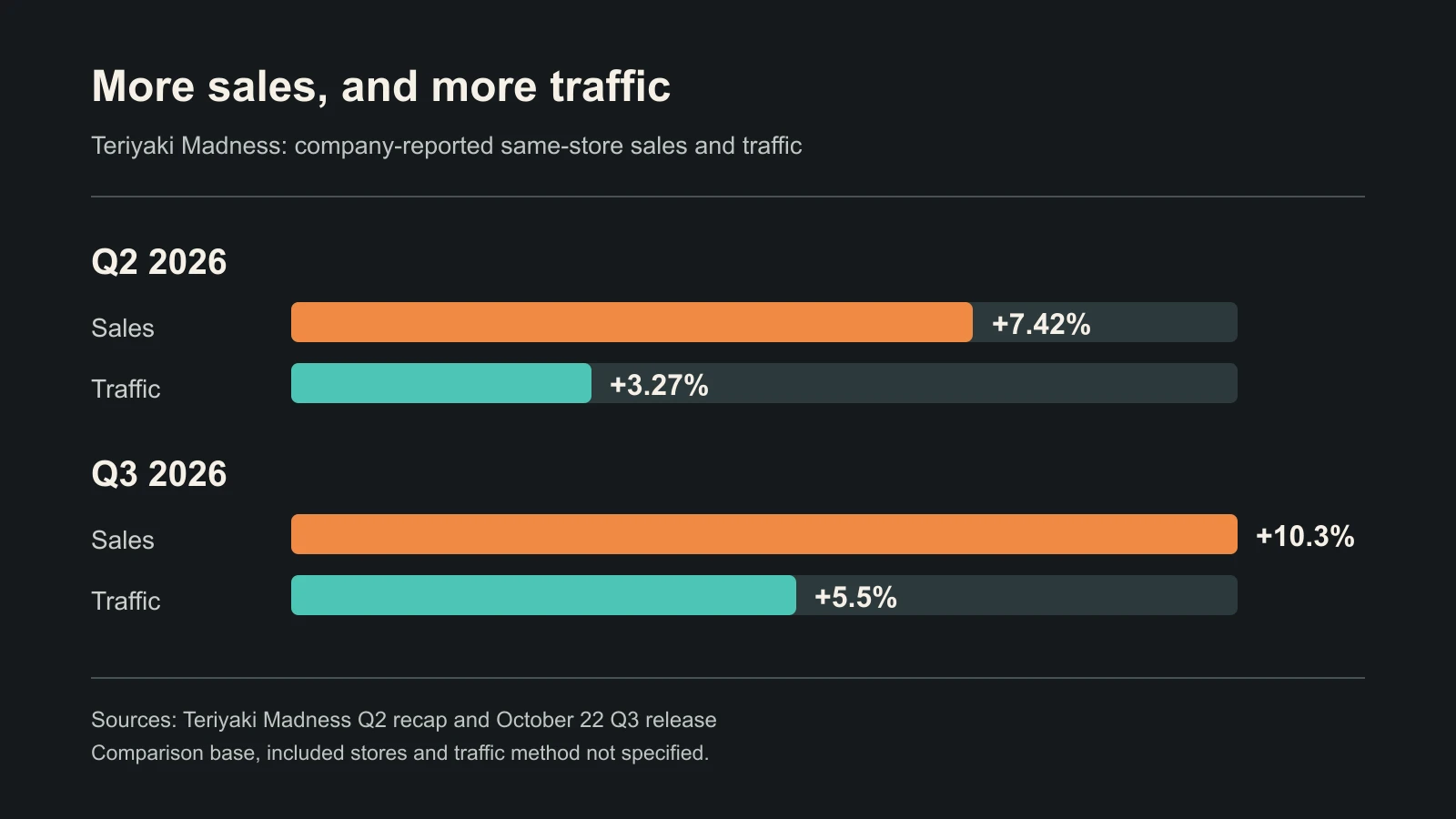
Teriyaki Madness reported third-quarter same-store traffic growth of 5.5% and sales growth of 10.3% in an October 22 update.
Separately, it reported nine openings, 229 locations and 25% year-over-year systemwide sales growth, including the expanding footprint.
Its Q2 recap put April–June same-store traffic growth at 3.27% and sales growth at 7.42%. Neither update specifies the comparison base or the stores included.
The Q3 release cites fast-casual benchmarks of 1.4% sales growth and a 2.6% traffic decline without identifying their source.
For its U.S. quick-service sample, Revenue Management Solutions reported Q3 traffic down 2.6%, average prices up 2.6% and net sales up 0.6%, all year over year. RMS attributed positive sales partly to higher prices. The matching traffic figures do not establish a shared sample.
Catering and digital orders#
Catering sales were 59% "above last year's pace," according to the announcement, which does not specify the comparison period. The June recap reported 59.15% year-to-date growth through June 30. Neither isolates Q3 catering growth or discloses channel profit.
Earlier interviews describe operations, without explaining Q3's traffic result. In a February interview with Food On Demand's Hans Lammeman, chief marketing officer Jodi Boyce recalled about 40 shops taking pickup orders by phone or at the counter in 2016. Online and app ordering arrived in 2017. By the interview, she said roughly 80% of food left restaurants through off-premise channels. For catering, Boyce described selecting items that "travel the best" and are "easiest to execute," with franchisee food costs part of that choice.
In a May interview with Restaurant Technology Guys' Jeremy Julian, Aunna Macias, then restaurant technology manager, described the brand's earlier problem with separate delivery tablets and manual order entry. Integration had become a requirement for adopting systems.
Macias said Olo handled online ordering and catering, while a move to Toast was underway. She described a gap in pacing online and third-party orders against the kitchen's workload, a project she hoped to revisit after the migration progressed. That account does not establish either project's current status.
Financial reporting had its own gaps. Macias said integrations conveyed items and required departure times, while third-party markups and promotions could remain outside the point-of-sale system. Franchisees could need several portals and bank statements to piece together performance.
QSR Pro Staff
The QSR Pro editorial team covers the quick service restaurant industry with in-depth analysis, data-driven reporting, and operator-first perspective.
More from QSR